Let’s be detectives in our own neighborhoods. Every area has its own big problems—the perennial pothole, zoning debates, and the weird smell from the local plant. Finding the top five issues is more than just listing complaints. It’s about understanding what really matters to everyone.
This is where community work starts. By using the Voter Engagement Tactics Guide, we can listen to more than just the loudest voices. We look for patterns in complaints. For example, is school funding always a topic on Facebook? Do the same infrastructure issues keep coming up at council meetings?
These patterns are clues to your community’s health. It’s like a civic check-up. Are people worried about safety, like street lights and crosswalks? Or is the main issue growth and development?
The goal is to go beyond small complaints to the big, systemic problems. This way, you can see what a candidate can really do. It turns vague complaints into a clear list of priorities. This helps you compare candidates based on real, important issues.
With this knowledge, you’re not just a voter. You’re an informed citizen who can ask the right questions. So, what are the top five issues keeping your neighbors up at night?
Gather Candidate Source Materials
Researching candidates is like detective work, but with more copying and pasting. You aim to create a detailed file on each candidate. This file should turn a mess of promises into a structured database.
Start by exploring the candidate’s online presence. Look at their campaign website and social media. Also, check local news, speeches, and voting records if they’ve been in office. Your goal is to organize everything in one place.
Use a voter guide template to guide your research. This template helps you organize policy positions, biographies, votes, statements, and media appearances. It ensures you compare candidates fairly.
Here’s a simple tracker to start your research:
| Source Type | What to Look For | Where to Find It |
|---|---|---|
| Official Platform | Formal policy papers, “Issues” page on campaign site | Candidate’s official website, press releases |
| Public Statements | Speeches, debates, interviews, social media posts | YouTube, C-SPAN archives, Twitter/X, local news |
| Voting Record | How they voted on key bills (for incumbents) | GovTrack, Vote Smart, official legislative websites |
| Financials | Campaign donations, major endorsements | OpenSecrets, FEC filings, local election boards |
Not all sources are equal. Campaign ads are different from in-depth interviews. Your goal is to collect materials that show real policy, not just showmanship. This systematic candidate sourcing is key to making informed decisions.
This stage is about gathering, not judging. You’re like a political archivist, not a critic. Your task is to create a detailed voter guide template. The more you gather, the better your choices will be.
Document Positions & Specific Plans
You’ve collected campaign mailers, op-eds, and candidate questionnaires. Now, it’s time to look beyond the promises. You want to see if candidates can back up their words with real plans. A scoring rubric is key to this.
Imagine grading a candidate like a student. You look for clear, specific plans, not just empty promises. This is where a scoring rubric shines, turning vague promises into something you can measure.
To create a scoring rubric, start with the top 5 community issues. For each, use a 5-point scale. For example:
- 1 Point (Vague): The candidate mentions the issue but has no plan (e.g., “I’ll fix the roads!”).
- 2 Points (General): They acknowledge the problem and support a broad solution (e.g., “We need to invest in infrastructure.”).
- 3 Points (Detailed Stance): They take a clear position (e.g., “I support the Main Street repaving project.”).
- 4 Points (Specific Plan): They propose a specific policy or solution (e.g., “I will allocate $2M for the Main Street project.”).
- 5 Points (Fully-Fledged Plan): They offer a detailed, funded plan with a timeline (e.g., “A 3-year, $6M plan, funded by the 2025 capital bond, to be completed by Q3 2026.”).
This scoring rubric helps move from vague promises to real plans. It’s not just about what they promise, but how they plan to do it. A candidate promising to fix potholes gets a 1. One promising to allocate $500,000 for Elm Street gets a 5. This shows the difference between a slogan and a real plan.
This method, inspired by the Ballot Proofing Guide, is your analytical tool. It’s not about agreeing with a candidate, but if they have a clear plan. By using this scoring rubric on key issues, you turn a confusing election into a clear, data-driven comparison. It shows who has a real plan and who just has a pitch.
Budget & Feasibility Review
A campaign promise without a budget is just a dream. In the world of values-based voting, your vote is a plan for your community’s money. We’re moving from applause to numbers. It’s time to check if promises can be kept.

The Budgetary Detective: Following the Money Trail
Every promise has a price tag. Your job is to find it. Look at the details of a new community center, not just the total.
Is the plan for a new park or road just talk, or is there a budget for it? A good review looks at how things will be done, not just what.
Think of yourself as a forensic accountant for the public good. When a candidate says “I’ll fix the roads,” you should ask:
- What’s the projected cost? Get a real number, not a range.
- What’s the proposed funding source? New bonds? A reallocation? A tax? If it’s “to be determined,” that’s a red flag.
- What’s the five-year maintenance cost? A new library is great, but who pays for the books and staff?
The “Values” in Value-for-Money
This is where values-based voting gets real. It’s easy to value “better schools,” but do you value them enough to prioritize them over a tax cut? A candidate’s budget shows their true priorities, not just what they say.
Looking at a budget is the ultimate test. It shows if their values—like affordable housing and green energy—are backed by money, not just words.
Fiscal Fiction vs. Fiscal Reality: A Side-by-Side
Let’s make it clear. Here’s how to spot the difference between a campaign fantasy and a real plan:
| Campaign Promise (The Fiction) | Fiscal Reality Check (The Detective Work) |
|---|---|
| “I will hire 50 new police officers.” | What’s the cost? (Salaries, cars, training, benefits). Is there a line item in the proposed budget? Is the police pension fund solvent enough to support this? |
| “I’ll fix every pothole in the district!” | What’s the current road maintenance budget? What’s the per-mile repaving cost? Is this a one-time infusion of cash or a new annual budget line? |
| “We’ll install solar panels on every municipal building.” | What’s the ROI? Is there a grant? What’s the maintenance and replacement schedule in the 10-year capital plan? |
Your Feasibility Toolkit: Three Steps to Fiscal Clarity
You don’t need an accounting degree. You just need a skeptical mind and a public budget document (which you can request).
- Source the Numbers: Ask the campaign or the candidate’s office for the “fiscal note” or cost analysis behind their major proposals. No details? That’s your first red flag.
- Cross-Reference with Past Performance: Has this candidate or party consistently over-promised and under-delivered on budgets in the past? Past fiscal behavior is the best predictor of future performance.
- Play the “What If” Game: If we fund this new program, what gets cut or what new revenue is identified? If the answer is “we’ll find efficiencies,” ask for three specific, current inefficiencies they’ve identified. Vague answers reveal a vague plan.
This isn’t about being a cynic; it’s about being a realist. Values-based voting isn’t just about sharing a candidate’s ideals; it’s about trusting their ability to turn those ideals into a functional, funded reality. The most principled vote is an informed one, and the budget is where principles meet the balance sheet.
Track Record & Experience
In politics, a candidate’s past is key to their future. It’s like checking a car’s history before buying. It shows their voting record, kept promises, and community ties. Past actions often predict future ones.
Looking for a pattern of behavior is important. Did they attend small town halls? Did they follow up on community projects? The Voter Engagement Tactics Guide says trust comes from consistent action, not just words.
When comparing candidates, check their history, not just their current plans. A long record of environmental work is different from a new interest. This shows real commitment, like a mature tree.
To evaluate, use clear metrics. The table below helps compare candidates based on their experience.
| Candidate | Years in Public Service | Key Legislative Focus | Community Trust Score* | Notable Project/Initiative |
|---|---|---|---|---|
| Candidate A | 12 years | Education Reform, Infrastructure | High | Spearheaded city-wide after-school program |
| Candidate B | 6 years | Small Business & Economic Development | Medium | Launched local business grant program |
| Candidate C | 20+ years | Environmental Policy, Public Health | Very High | Led coalition for city-wide green energy initiative |
*Trust score based on local approval ratings & community feedback surveys.
This table is more than a scorecard. It starts a conversation. Notice, years in service alone isn’t enough. Candidate B’s recent, focused effort might be what a district needs. The Voter Engagement Tactics Guide says trust comes from both experience and results.
To compare candidates well, look at the “how” and “why.” Did their actions match their values? Did they work with others or alone? Tools like this candidate scoring sheet help you analyze. It’s like a political balance sheet, showing kept promises and broken ones.
In the end, a candidate’s track record is unique and honest. Treat it with the same scrutiny as a used car’s history. Then, you’ll vote with data, not just hope.
Community Presence & Constituent Services
You’ve seen TV ads and read mailers. But the real test of a candidate is in person. It’s about showing up in the school gym and at the coffee shop. This is the ground game.
This part of your voter guide template focuses on the person who shows up when no one is watching. We’re looking at if a candidate is a partner in governance or invisible. It’s about their “show-up-ability.”
Beyond the Podium: Evaluating the “Where” and “When”
It’s like political show-and-tell for adults. A candidate who only shows up for ribbon-cutting ceremonies fails. We want the one who attends the 7 a.m. zoning board meeting too.
The voter guide template for this section looks at a pattern of presence. A candidate who holds regular town halls is building a relationship. But, if they send a staffer to a contentious meeting, they’ve lost the plot.
We’re grading on the “pothole test.” If a constituent calls about a problem, does the candidate’s office act? This shows true constituent services.
The “Invisible” Work: The Real Constituent Services
Forget the photo-ops. The real work is in the casework. How a candidate’s office handles small problems shows their priorities.
Do they have a system for tracking and resolving issues? A candidate’s past record or current system is a clear indicator. A voter guide template should ask: do they have a process, or just PR?
The Ground Game Checklist: Your Voter Guide Template in Action
Don’t just take their word for it. Use this checklist to score candidates on their community presence. This is your voter guide template for action, not just observation.
| Metric | What to Look For | Why It Matters |
|---|---|---|
| Accessibility | Do they hold regular, in-person town halls in different neighborhoods? | Measures their commitment to two-way dialogue, not just broadcasting. |
| Responsiveness | What’s the average response time to a constituent email or call for help? | Shows if they see constituent service as a core function or a nuisance. |
| Constituent Services Track Record | Can they point to specific, non-partisan problems they’ve helped solve for residents? | Demonstrates effectiveness and follow-through, not just promises. |
| Staff & Infrastructure | Do they have a system for tracking and resolving issues? | Indicates a professional, service-oriented operation, not just a campaign. |
From Theory to Ballot: The Final Litmus Test
In the end, this part of your voter guide template is about the “political gut check.” It’s the difference between a politician and a public servant. The candidate with a deep, authentic community presence is building a constituency.
They’re not just seeking power; they’re accepting a responsibility. When you cast your vote, you’re not just choosing a policy platform. You’re hiring a representative. The one who shows up for the pothole will show up for the big fights too. That’s the candidate who earns a checkmark on your ballot.
Accountability Promises
Promises in politics are common. Every election, we hear big promises, like fixing potholes or bringing back the pancake breakfast. But, broken promises cost a lot. That’s why we need to score them.
Imagine a Yelp for political promises. Our goal is to create a scoring rubric that’s as strict as a Swiss watch. We’re not just asking if they did it. We want to know how well, on time, and if it was what they promised.
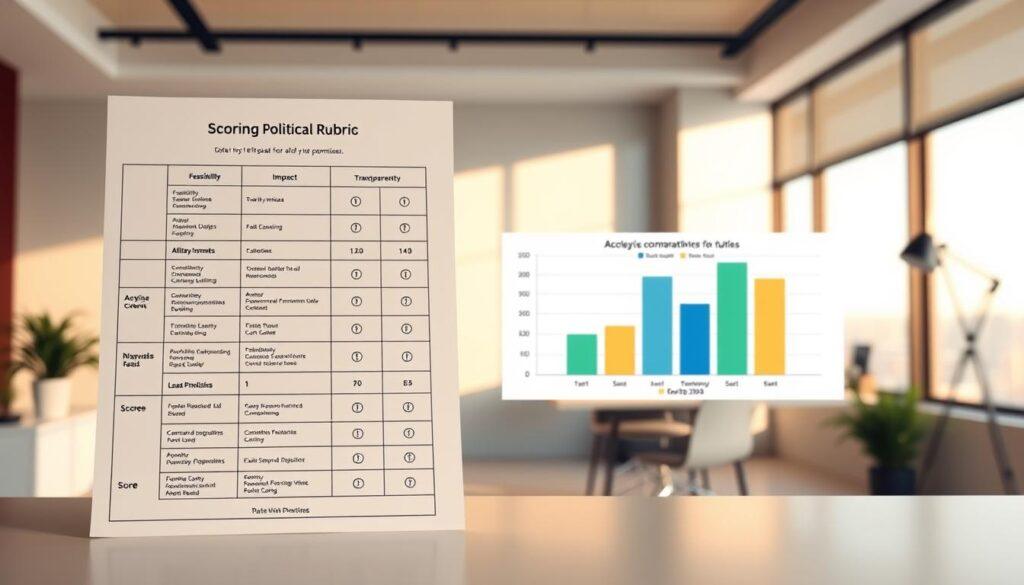
We ignore vague promises. Our scoring rubric checks every promise closely. Saying you’ll “improve education” isn’t enough. We want specifics like funding and teacher ratios.
Our scoring rubric has four main points. We check every promise against these:
- Specificity & Measurability (25 points): How clear is the promise? “Improve schools” gets a 0. “Increase funding by 15% and add 10 STEM teachers at Central High by Q3” gets a 25.
- Progress Tracking (25 points): Can we track progress every quarter? Did they share a timeline? We give points for being open and setting goals.
- Fiscal Feasibility (25 points): Is it in the budget? Does their plan for tax cuts and new community centers add up, or is it just campaign talk?
- Public Accountability (25 points): Are they sharing progress publicly? Holding town halls? Or did the promise disappear after the election?
This isn’t about catching politicians in lies. It’s about treating promises seriously, like a financial audit. We give a score from 0-100, making promises clear and measurable.
The beauty of our scoring rubric is its simplicity. It cuts through political spin. A candidate can’t just say they’ll “support small business.” We want to know if they’ll cut the license fee, by how much, and when.
We’re not just making a scorecard; we’re creating a permanent record. A place where promises can be compared to results. This scoring rubric makes promises real and enforceable.
This scoring rubric turns political promises into something you can measure. It’s the difference between saying you’ll “support education” and promising to increase the school budget by 7% in 18 months. One is just a soundbite. The other is a promise you can track and score.
Create Scores & Weights
Think of this as your personal political fantasy draft. You’re not just picking players; you’re the GM. The stats you care about are issues like healthcare access, climate policy, and economic equity. This is where we move from having values to quantifying them, transforming your principles into a scoring system.
It’s fantasy football, but the championship is a functioning democracy.
We’ll use a method called pairwise comparison. It’s a simple but powerful way to force yourself to make tough choices. You don’t just rank issues from 1 to 5. Instead, you take every issue and compare it directly to every other issue, two at a time.
For example, let’s say your top issues are: Climate Action (A), Universal Healthcare (B), and Public Education Funding (C). You don’t just rank them. You ask: Is Climate Action more important than Universal Healthcare? If yes, Climate gets a point. Then, is Climate Action more important than Education Funding? And so on, for every possible pair.
An example of a completed pairwise comparison for three policy issues.
The issue that “wins” each head-to-head matchup gets a point. After all the matchups, you tally the wins. This gives you a raw score for each issue. Then, you simply convert those raw scores into a percentage weight.
| Issue | Raw Score (Wins) | Weight (Percentage) |
|---|---|---|
| Climate Action | 2 | 40% |
| Universal Healthcare | 1 | 30% |
| Education Funding | 0 | 20% |
| Tax Reform | 1 | 10% |
Now, the magic happens. Let’s say you have two candidates, Candidate A and Candidate B. You rate each candidate on a scale of 1-10 for how well they represent your stance on each issue. Then, you multiply their score by the weight of that issue. Add it all up, and you get a total weighted score for each candidate.
| Issue | Weight | Candidate A (Score x Weight) | Candidate B (Score x Weight) |
|---|---|---|---|
| Climate Action (40%) | 40% | Candidate A: 8/10 * 40 = 3.2 | Candidate B: 5/10 * 40 = 2.0 |
| Healthcare (30%) | 30% | Candidate A: 6/10 * 30 = 1.8 | Candidate B: 9/10 * 30 = 2.7 |
| Education (20%) | 20% | Candidate A: 7/10 * 20 = 1.4 | Candidate B: 7/10 * 20 = 1.4 |
| Tax Reform (10%) | 10% | Candidate A: 4/10 * 10 = 0.4 | Candidate B: 6/10 * 10 = 0.6 |
| TOTAL SCORE | 6.8 | 6.7 |
In this scenario, while both candidates are close, Candidate A’s stronger stance on the heavily-weighted Climate Action issue gives them the edge. This isn’t about picking a “winner” in the traditional sense. It’s about moving past gut feelings and into values-based voting with a clear, defensible logic.
You’re not just voting for a name; you’re voting for a weighted, calculated reflection of your priorities.
Consensus-Building in Your Group
You’ve done your homework. You’ve gathered all the information and now you’re looking at a spreadsheet of candidate scores. It might look like a game of Battleship. But, it doesn’t have to be a fight. The Voter Engagement Tactics Guide can help you find common ground.
Imagine this as a high-stakes book club. Instead of discussing a novel, you’re talking about policy. The goal is to find a decision everyone can support, even if it’s not their first choice. It’s about moving from “my candidate” to “our candidate.”
The Book Club Method: Discussion, Not Debate
Use the “book club” approach. You wouldn’t argue with a friend over a different character. Instead, you’d discuss the book’s themes. When comparing candidates, focus on discussing, not debating.
Start by having each member share their top issue. This helps focus the discussion on shared priorities, not just personalities.
Facilitation, Not Domination
Choose a neutral facilitator to keep the conversation flowing. Their role is to manage the discussion, not control it. They should have a few tools in their kit:
- The “No Rebuttal” Round: Have everyone share their top choice and one reason why, without interruptions. This often reveals common strengths and consensus.
- The “Worst-Case” Test: Ask about the biggest risk of each leading candidate. This helps move from advocacy to strategic analysis.
- The Matrix Method: Create a 2×2 grid to compare candidates. Plot them based on “Alignment with Our Group’s Top Issues” and “Electability/Feasibility.” This can make the best choice clear.
Handling the Stalwart Supporter
You’ll have someone who strongly supports a candidate. Acknowledge their passion, then use data to compare candidates. For example, “Your candidate is strong on environmental policy. Let’s compare candidates on that specific issue using their voting records.”
The Final Tally: From Talk to Decision
When it’s time to decide, use a method that reflects the group’s opinion. Avoid simple show of hands. Instead, use a preferential vote or ranked-choice system. Writing down your choice privately can lead to a more honest decision.
Consensus isn’t about everyone agreeing. It’s about everyone feeling the process was fair and focused on the group’s goals. You’re not just picking a candidate; you’re strengthening your group’s unity. That’s a victory in itself.
Template & Examples
So, you’ve done the work. You’ve found the problems, checked the candidates, and looked at their promises. Now, it’s time to make your own voter guide template. Think of it as a guide for making smart political choices, your own way to spot fake promises. This isn’t about who’s the most popular; it’s about who’s best for the job in your community.
Here’s the template, based on the League of Women Voters, Vote Smart’s data, and Ballotpedia’s fairness. First, list your top five local issues. Then, add the candidates. Under each name, list their real votes (not just speeches), their past actions, and their promises to be accountable. Use a 1-5 scale to rate them on each issue. It’s not about finding the perfect candidate; it’s about finding the one who does the least wrong on your issues.
Your voter guide template is more than a checklist; it’s a statement of informed voting. It turns you from a passive voter to an active, thinking voter. This tool helps you cut through political noise and fake promises. Use it to go from feeling like a spectator to being the most informed voter in the booth.