Drive through transit-hub municipalities like Rahway, Cranford, or Westfield, and you will see the same thing: massive, multi-story, high-density apartment complexes rising near the train stations. Local politicians often champion these developments as economic revitalization. But behind the ribbon-cutting ceremonies lies a financial mechanism that is quietly suffocating our local public schools: the PILOT agreement.
PILOT stands for “Payment In Lieu Of Taxes.” To incentivize developers to build, municipalities grant them long-term tax exemptions, sometimes lasting up to 30 years. Instead of paying standard, fluctuating property taxes based on assessed value, the developer agrees to pay the town a fixed annual fee.
Here is where the math becomes a crisis for Union County taxpayers.
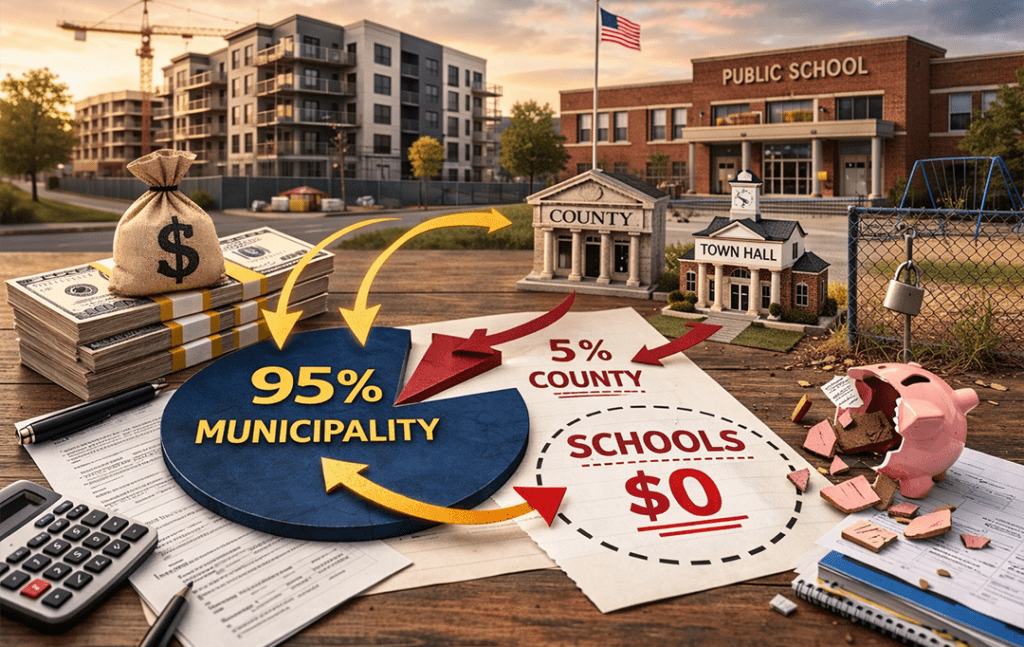
The 95/5 Split and the Zero-Dollar School Problem
Under standard New Jersey property tax distribution, the revenue is split three ways: the municipality, the county, and the public school district. Because schools are the most expensive public service to run, they typically receive the largest slice of that pie—often over 60%.
However, under a standard PILOT agreement under New Jersey’s Long Term Tax Exemption Law, the distribution changes drastically. The municipality keeps 95% of the developer’s payment. The county gets 5%. The public school district gets zero.
The Burden on the Taxpayer
These new high-density developments inevitably bring new residents, and those residents bring children who enroll in Union County’s public schools. If a new 200-unit complex adds 50 new students to a district, the cost of educating those children increases the school board’s budget. Yet, because of the PILOT agreement, the developer contributing to that population boom pays absolutely nothing into the school system.
Who makes up the difference? You do. The burden of funding the expanding school budget falls squarely on the shoulders of the existing residential homeowners, driving our already astronomical property taxes even higher. It is time to demand transparency. Before our town councils approve another sweetheart deal for luxury developers, residents must review our guide to understanding Union County property tax assessments and demand that municipal leaders mandate fair-share school funding in every future development contract.
For a deeper understanding of the statutory framework allowing these agreements, citizens should review the guidelines provided by the New Jersey Department of Community Affairs.