Let’s be honest. In most conversations, public awareness is often just a buzzword. It’s quickly passed over for something more exciting.
But, if you look closer, public awareness is key to a healthy democracy. It turns private worries into public actions. It’s like a community’s big “aha” moment.
This moment is when everyone says, “That’s a problem.” Then, they can all say, “Let’s fix it.”
My research shows that awareness is the first step. It moves issues from being ignored to being talked about openly.
Studies back this up. They show that getting involved in civic activities makes communities stronger. It lets people have a say in their world. This understanding is the base for any action.
Without awareness, efforts like public outreach campaigns fall flat. It’s like shouting without anyone listening.
In short, public awareness is the start of real democracy. It’s when actions turn into real change, like a neighbor organizing a clean-up.
Defining Your Cause
Starting an advocacy campaign without a clear cause is like trying to do surgery with a butter knife—it’s messy and doesn’t work. The excitement is in the action, but the real work is in the planning. Before you start, you need to know exactly what you’re fighting for.
Is your issue a symptom or the main problem? This question is key to making a real impact. A vague goal like “improving education” is like a black hole for effort and resources. A clear goal is “getting annual funding for after-school STEM programs in three under-resourced schools in the north district.” This shows the difference between a vague idea and a clear goal.
This step is all about real civic action. Research shows that getting involved in your community strengthens democracy. But you can’t do that if you’re shouting into the wind. Being clear gives you power. When you know exactly what needs fixing, you can work together with others to find real solutions.
Your role is to tell stories and analyze data. Listen to what people in your community are saying through town halls and surveys. Then, match those stories with hard facts like enrollment numbers and budget details. This mix of heart and numbers is what makes you a true advocate, not just someone who cares.
Here’s a simple test: can you explain your cause in one minute? If not, you’re not ready yet. A clear cause statement is your guide. It keeps your campaign focused, even when things get distracting.
| Attribute | Vague Cause (The Symptom) | Defined Cause (The Disease) |
|---|---|---|
| Focus | Broad, abstract goal (e.g., “Fight poverty”) | Specific, tangible objective (e.g., “Advocate for a city ordinance to fund a summer meals program for students in Title I schools”) |
| Measurability | Success is unclear; metrics are fuzzy. | Success is quantifiable (e.g., “Secure funding for 500 students by June 30”). |
| Community Mobilization | Attracts general sympathy but limited action. | Enables targeted recruitment (e.g., parents, teachers, local businesses in affected districts). |
| Message Clarity | Message gets diluted; easy for opponents to misinterpret. | Creates a clear, repeatable, and defensible core message. |
| Likely Outcome | Campaign fizzles out, resembling a forgotten Twitter trend. | Builds sustained momentum and creates a clear path for negotiation and victory. |
This first step is all about listening. It’s about moving from assuming you know what the community needs to actually understanding it. “Addressing community needs is at the heart of meaningful civic engagement,” and you can’t address what you haven’t properly diagnosed.
Once your cause is clear, everything else falls into place. You’re not just raising awareness; you’re building a strong case. And a strong case is what turns a simple campaign into a real movement. Now, with your cause defined, you’re ready to plan your next steps.
Strategies (Events, Social Media, Media Outreach)
Defining your cause is like writing a manifesto. Deploying strategies is like building a movement, one tweet, town hall, and op-ed at a time. It’s your tactical playbook, where idealism meets real-world execution. Think of it as conducting an orchestra where every instrument must play its part at the right moment.
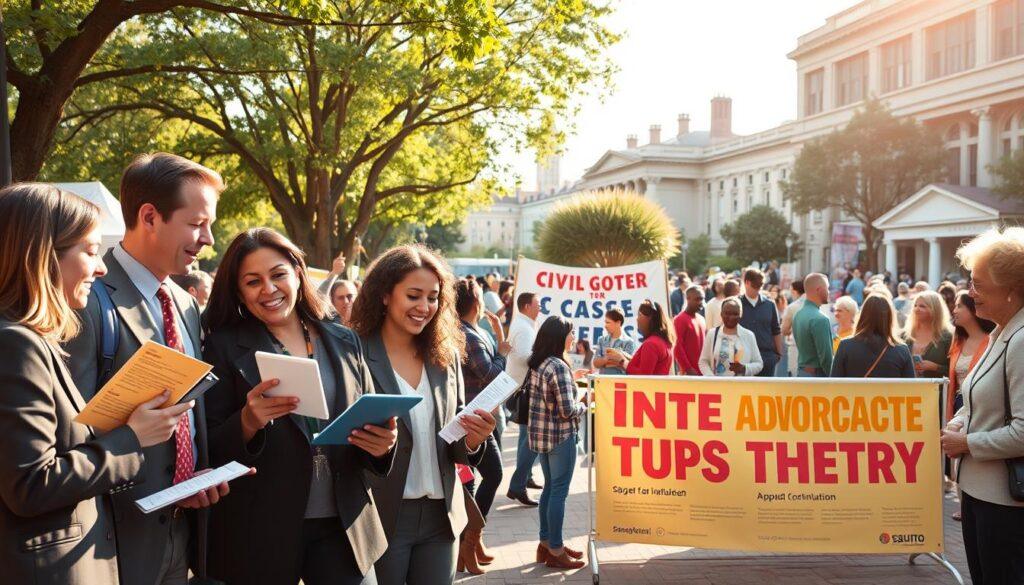
The town hall meeting is like the classic rock anthem of civic engagement. It’s familiar, sometimes a little clunky, but it commands a loyal and attentive audience. Its power is visceral—it creates a tangible, human connection that pixels simply cannot replicate.
Hosting a public forum is political theater where your community members are the stars. The key to modern success? Hybrid accessibility. By allowing both in-person and virtual attendance, you dramatically amplify your reach. A local parent can attend from their kitchen, while a passionate student joins from their dorm room. This dual approach turns a local meeting into a regional event.
Never underestimate the formal weight of a written record, either. Coordinated letter-writing campaigns to policymakers provide a concrete paper trail of public opinion. It’s old-school, but in the halls of power, ink on letterhead speaks volumes.
Social Media: Your Guerrilla Marketing Wing
This is where you meme-ify your message and recruit your digital army. But beware the siren song of “slacktivism.” A thousand shares are meaningless if they don’t convert into one hundred petition signatures or ten new, boots-on-the-ground volunteers.
Platform choice is strategic warfare:
- Instagram & Snapchat: Your visual recruitment officers. Use them to tell the story of the problem and the people involved. They are exceptionally effective for rallying local youth and volunteers with compelling imagery and short, impactful videos.
- Twitter (X): The rapid-response commentary desk. Ideal for live-tracking policy developments, engaging directly with officials, and mobilizing supporters for quick, flash-style actions.
- Facebook: The community bulletin board for the 35+ crowd. It remains the best digital tool for organizing local events, sharing detailed updates, and facilitating group discussions. It’s for the demographic that appreciates a well-designed digital flyer.
Each platform serves a distinct function in your broader advocacy campaigns. Use them with precision, not as a blanket megaphone.
Media Outreach: Earning the Legitimacy Stamp
This is the long game. A well-placed op-ed in the local paper or a thoughtful segment on the regional news is the cultural analog of getting a verified blue checkmark. It signals that your cause has weight, credibility, and deserves a seat at the adult table.
This form of outreach transforms your movement from a “protest” into a “story.” Journalists need narratives. Provide them with a clear, human-centric angle, compelling data, and accessible spokespeople. A news story applies a different kind of pressure on decision-makers than a protest sign—it’s pressure from the court of public opinion.
The magic, the exhausting yet beautiful part, is in the blend. A clever social media campaign drives attendance to your hybrid town hall. The energy and stories from that forum give a reporter a perfect hook. The resulting news story validates your efforts and applies fresh pressure on policymakers.
It’s a virtuous cycle. One channel fuels the next. Your advocacy campaigns become self-reinforcing. Events provide the human heart, social media provides the nervous system, and media coverage provides the authoritative voice. Master this trifecta, and you’re not just raising awareness—you’re building a legacy.
Measuring Success
Measuring public awareness is like being a poet and an accountant at the same time. You need to track both the soft, feel-good vibes and the hard numbers. If you’re not tracking, you’re just doing something loud and passionate without results.

First, let’s look at the numbers. Quantitative metrics give you a clear picture. These are the numbers that don’t lie, even when they’re not what you hoped for.
- Website Traffic: A sudden increase in visits to your cause page is a big deal. It shows people are curious.
- Petition Signature Growth Rates: How fast signatures are coming in matters. Is the momentum growing or slowing down?
- Social Media Engagement: It’s not just about likes. Saves and shares show real interest. People are keeping your message for later.
- Event Attendance & Volunteer Sign-ups: Seeing people at events and signing up to help is proof of success. It shows your message is resonating.
This data is linked to the health of our society. For example, high voter turnout shows a strong democracy. It’s the result of your efforts to get people involved.
But there’s also the softer side. Qualitative shifts are the real gold. Has the local media started talking about your issue in a new way? Are politicians mentioning your ideas in speeches?
The best sign of success is when the community starts talking differently. If people go from complaining about a pothole to discussing a bigger issue, you’ve won. You’ve changed the conversation.
So, how do you measure these changes? Use surveys before and after your campaign. Analyze comments online. Look at letters to the editor. This is the work of defining success beyond just numbers.
In the end, a successful campaign changes both the numbers and the community’s mindset. It shows you’re not just making noise—you’re making a difference.
Inspiring Examples
Our case studies show the playbook in action. But let’s look at something different. Sometimes, the most powerful awareness comes from a mural. Art can reach people in a way that words can’t.
Think about the global spectrum of cause-based art. From the AIDS Memorial Quilt to environmental installations, it’s all about feeling the issue. These works turn abstract problems into something we can all relate to.
But art alone isn’t enough. It needs to connect with real-world actions. Effective advocacy campaigns mix emotional appeal with policy work. You need to know how to engage with local officials to make a difference.
So, what’s your way to make a difference? Is it through voter drives, community gardens, or street art? Every successful movement has a clear cause, a mix of strategies, and a strong message. Your outreach is what makes your impact. Now, go make some noise.