IRS rules are like playing constitutional jazz. You must know when to improvise and when to follow the rules. The IRS might not be funny, but their 501(c)(3) nonpartisan rules are as dry as The Office.
We’re figuring out what’s okay and what’s not in voter education. Think of it like neutral voter registration drives and forums that don’t turn partisan. We’ll use First Liberty Institute and IRS Rev. Rul. 2007-41 to guide you.
IRS guidance on campaign intervention isn’t exactly exciting. But getting it right lets your organization engage without losing tax-exempt status. Let’s navigate this legal tightrope together.
Getting clergy and lay leaders on board
Getting pastors excited about voter drives is like teaching cats to swim in sync. It’s theoretically possible but very rare. The trick is to see church voter registration as a spiritual duty, not just politics.
Remember Exodus 18:21? Jethro told Moses to pick men who fear God. This is more than old advice; it’s a biblical call to action. When leaders are righteous, everyone is happy, as Proverbs 29:2 says.
Father Frank Pavone’s “Citizenship Sundays” shows how to mix civic duty with worship. It changes “We can’t get involved in politics” to “We must fulfill our biblical duty.”
Different clergy need different ways to be convinced. Some like theological arguments, others the practical benefits. Your congregation outreach will succeed if you match your approach to their values.
| Clergy Type | Preferred Approach | Biblical Reference | Practical Benefit |
|---|---|---|---|
| The Theological | Scriptural foundation | Exodus 18:21 | Spiritual obedience |
| The Pragmatist | Community impact | Proverbs 29:2 | Stronger leadership |
| The Cautious | Legal compliance focus | Render unto Caesar | IRS 501(c)(3) safety |
| The Activist | Historical precedents | Civil rights movement | Legacy building |
Lay leaders can be your biggest supporters. They connect with everyday concerns and can speak up from within. Give them solid talking points and biblical backing.
The best church voter registration campaigns make clergy supporters, not leaders. When the shepherd leads, the flock follows. But the shepherd must believe in the path.
Your congregation outreach should show how nonpartisan voter engagement helps the community. It’s about empowering people, not pushing agendas. Frame it as helping members use their God-given rights and duties.
Always be ready to address church-state separation concerns. Have IRS guidelines at hand. Show how other churches have successfully done this while keeping their tax-exempt status.
The goal isn’t to make pastors political. It’s to help them see civic engagement as part of their ministry. When done right, everyone wins – the church, the community, and democracy itself.
Scheduling around services and holidays
Timing your church voter registration drive is like trying to thread a needle while riding a rollercoaster – miss the window and you’re just another spectator. The liturgical calendar isn’t just about holy days; it’s the strategic playbook for effective congregation outreach.
Let’s talk about the 30-60 day pre-election sweet spot. Most states require registration 30 days before elections, making this period your golden hour. It’s the political equivalent of catching the wave just before it breaks.
Three consecutive Sundays before the deadline isn’t just a suggestion – it’s your holy trinity of voter engagement. This approach transforms your effort from a one-off announcement into a sustained conversation.
July 4th isn’t merely about fireworks and barbecue. It’s prime real estate for citizenship sermons that naturally segue into voter registration. Patriotism and civic duty make better bedfellows than you might imagine.
Here’s what to avoid: scheduling during Christmas pageant rehearsals or Easter preparations. That’s like trying to sell snow shovels in Hawaii – technically possible but practically pointless.
Your scheduling matrix should balance:
- Major holiday weekends (boost attendance)
- Liturgical seasons (avoid penitential periods)
- Local community events (prevent calendar conflicts)
- State registration deadlines (non-negotiable)
The electoral clock stops for no one. Those registration deadlines are Cinderella’s carriage waiting to turn back into a pumpkin. Plan according, and your congregation outreach will hit all the right notes at precisely the right time.
Script for announcements and bulletin inserts
Creating the perfect voter registration message is like writing a poem for the community. It’s not just about following rules. It’s about inspiring people to take action while staying within the law.
Imagine your congregation outreach as a mix of Shakespeare and Churchill. Every word should have impact. Every sentence should flow smoothly. The goal is to grab people’s attention and keep it.
Your pulpit announcements should feel like a call to duty, not just a legal notice. Here’s how to craft your 60-second message:
- Start with why civic engagement is important to your faith community
- Clearly state that voter registration is nonpartisan
- Provide specific dates, times, and locations
- End with a message that inspires and connects to your values
Here’s some language that works: “Friends, our faith calls us to be active in our community. This Sunday, we’ll have voter registration help after services. No politics, just practical help. Every voice matters in building our community.”
For your bulletin inserts, focus on design, not dumping information. These should be worth reading, not just tossed. The key is to highlight benefits, provide clear details, and avoid bureaucracy.
| Section | Traditional Approach | Engagement Approach |
|---|---|---|
| Headline | “Voter Registration Information” | “Make Your Voice Heard: Voter Registration Sunday” |
| Body Text | Paragraphs of legal requirements | Bullet points with benefits and practical details |
| Call to Action | “Please consider registering” | “Join your neighbors in the fellowship hall after service” |
| Visual Design | Dense text, small font | Ample white space, clear headings |
Remember, your multilingual registration materials are just as important. They need the same care as your main content. Direct translations often miss cultural and emotional details.
Good bulletin inserts respect people’s time and offer value. They answer the key question: “Why should I care about this right now?”
The best part? These materials do more than just register voters. They show your congregation outreach cares about the community’s civic health.
Multilingual and accessible materials
Imagine hosting a voter registration drive that only serves English speakers. It’s like throwing a party and leaving half the guests at the door.
Congregation outreach means reaching people in their own languages and with their abilities. It’s not just about diversity. It’s about recognizing that everyone experiences the world differently.
The Americans with Disabilities Act requires voter registration forms to be accessible. This includes large print, braille, and digital options. These materials must be usable by everyone, regardless of their abilities.
Language is also a big deal. Google Translate is okay for menus, but it’s not good enough for voter forms. Multilingual registration materials need to be culturally sensitive, not just translated word for word.
Here are some ways to engage with your community in multiple languages:
- Collaborate with bilingual members for accurate translations
- Use visuals that connect with different cultures
- Offer materials in the top languages spoken in your community
- Train volunteers to help with language barriers
What makes voter registration materials truly inclusive?
| Material Type | Accessibility Features | Languages Needed |
|---|---|---|
| Registration Forms | Large print, high contrast, braille | Spanish, Mandarin, Arabic |
| Instruction Sheets | Simple language, visual guides | Vietnamese, Korean, Tagalog |
| Directional Signs | Universal symbols, clear fonts | Bilingual where appropriate |
| Volunteer Materials | ADA compliance training | Language-specific guidelines |
Disenfranchisement is a moral issue, not just a political one. Making voter registration accessible to all is not just following laws. It’s living out our faith’s radical inclusion.
Your multilingual registration efforts should feel like an invitation. The goal is to make every member feel seen, heard, and ready to participate in democracy.
Childcare, transportation, and elder support
Ever tried parking a minivan full of kids while helping your grandma vote? That’s America’s civic challenge.
Our congregation outreach tackles these barriers head-on. It’s like a Rube Goldberg machine for voting – complex but works when it all comes together.
Let’s look at the three main parts of voting access:
- Childcare that actually works: Not just crayons, but real activities during voting hours
- Transportation systems: Shuttles that are easy to use, not chaotic
- Elder support: Help from start to finish that respects their dignity
For church voter registration drives, childcare is key. It lets parents focus on voting without distractions.
Transportation solutions are simple. From carpooling to church vans, it’s neighbors helping neighbors vote.
Elder support needs care. It’s about helping without taking over. Many seniors want to vote but need a little help.
This approach makes congregation outreach real. It’s not just talk – it’s action that helps people vote.
Every parking spot, every hour of childcare, every shuttle route matters. It’s not politics – it’s helping people participate.
Privacy, safety, and pastoral care alignment
Imagine trying to organize a voter drive while keeping secrets like a confessional booth. This is the challenge we face. The mix of church voter registration and privacy is key. It’s where trust and civic duty meet.
Voter info needs the same care as a secret shared in church. Think of registration forms as sacred texts. They hold personal info that must be kept safe. The 501(c)(3) nonpartisan rules help protect your church and its tax status.
Creating safe spaces for public events is like nesting dolls. We need physical, digital, and emotional safety. How do you make people feel safe to vote without worrying about their info?
Your voter registration table should feel like a part of your community. It should blend with your church’s care. The person helping you register should also offer support later.
It’s a fine line: encouraging people to vote while keeping their info private. Your system should be open to build trust but secure to protect data.
Three key things to think about:
- Keep physical documents safe with locked storage
- Protect digital info if you use electronic methods
- Train volunteers on keeping info private
When pastoral care and voting work together, you’re not just registering voters. You’re building community. It’s like spiritual jazz, where freedom and structure blend.
Protecting privacy isn’t about hiding. It’s about building trust for real engagement. When people feel safe, they participate fully. That’s where change starts.
Partnering with local election officials
Working with government feels like trying to put together IKEA furniture without instructions. But, election officials really want your help. They’re just overwhelmed by paperwork.
This partnership is like a dance, with the IRS watching. You’re passionate about church voter registration, and they focus on details. It’s a perfect match.
Start by contacting the county clerk’s office. Don’t call during busy election times. Be the organized partner they need by:
- Scheduling a meeting when they’re not busy (like February or August)
- Bringing your 501(c)(3) determination letter as proof
- Asking about deputization requirements for your state
Deputization lets your volunteers act as temporary election officials. In Texas, it feels like becoming a wild west sheriff. Other states have similar programs that legally empower your team.
Bulk submission rules change fast, like TikTok trends. What worked last time might not now. It’s smart to have one person act as the liaison with the clerk’s office.
Those 501(c)(3) nonpartisan rules are your ally. Election officials like working with groups that know the rules. It’s like knowing exactly what dish to bring to a potluck.
The paperwork might look scary, but it’s your chance to show professionalism. Detailed documentation shows you respect their work. It makes your church a valued partner in the community.
Successful partnerships mean understanding their limits while keeping your church voter registration goals. It’s about finding a balance between community service and government rules.
When you get it right, you’re not just following rules. You’re building bridges for future civic engagement. And that’s worth some paperwork.
Volunteer screening and training
Building a volunteer team for voter registration is like finding top talent. It’s not just about getting people involved. It’s about creating a dedicated team for civic action.
Our screening starts with a “partisan detector test.” It’s not a lie detector, but it’s close. We ask about political views, campaign work, and current issues without mentioning politicians.
The training is strict, like a constitutional law and an IRS guide combined. Volunteers learn to share helpful info without supporting any party. They practice answering tough questions without showing bias.
Our training stands out because of:
- Role-playing scenarios that would impress method actors
- IRS compliance drills to make volunteers nonpartisan experts
- Multilingual registration materials training for diverse outreach
- Ongoing supervision that’s very attentive
The multilingual aspect is key. It’s not just about translating. It’s about understanding different cultures. Volunteers learn to help Spanish and Cantonese speakers in unique ways, recognizing cultural differences.
We have a strict three-strike rule. First offense: retraining. Second: suspension. Third: you’re out. This rule stops volunteers from mentioning their favorite candidate.
This system makes volunteers precise and neutral. They become ambassadors for voting, not for any party. They promote the act of participating in democracy.
Event-day flow and signage
Imagine Sunday morning at your church, where voter registration is as sacred as communion. Pulling this off needs urban planning skills and IRS knowledge.
The pew method is like a secret mission. Registration cards are slipped into hymnals. It’s sneaky yet effective, making everyone participate without noticing.
The table approach is like a chess game. It must be placed near coffee but not in the way. The goal is to be welcoming yet safe.
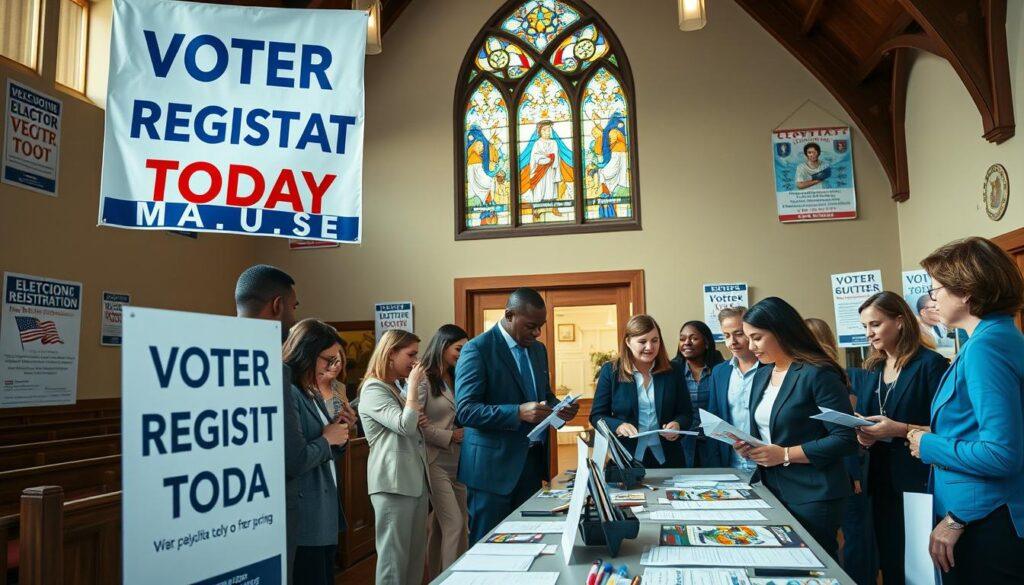
Signage must shout “Register here!” while whispering “We’re nonpartisan, IRS!” It’s a delicate balance. Signs should guide without showing bias, like airport signs.
Smooth traffic flow is key. You want people to move from pew to registration easily. No one should get stuck or confused.
Here’s how different methods compare:
| Distribution Method | Reach Percentage | Volunteer Requirements | IRS Compliance Risk | Ideal Church Size |
|---|---|---|---|---|
| Pew Distribution | 95-100% | 2-3 volunteers | Low | Small to medium |
| Table Setup | 60-75% | 4-6 volunteers | Medium | Medium to large |
| Hybrid Approach | 85-95% | 5-8 volunteers | Low to medium | All sizes |
Remember, 501(c)(3) nonpartisan rules are strict. Every detail must pass the nonpartisan test.
The aim is a church voter registration event that feels natural and complies fully. It’s a dance of civic engagement, almost a religious ritual.
Follow-up without advocacy crossing lines
The morning after your voter drive feels like the day after a great party. You want to follow up without being that annoying host who keeps texting about the cleanup. This phase is where congregation outreach can accidentally cross into advocacy, like texting your ex after midnight.
How do you remind people to vote without sounding like a political operative? Timing and tone are key. Send reminders during early voting, not on Election Day. Emphasize voting as a civic duty, not a specific outcome.
For multilingual registration follow-ups, provide election info in the same languages as registration. This keeps things consistent and avoids targeting specific groups for partisan reasons.
Transportation assistance needs care. Offer rides to polling locations without caring about voting choices. Say “We’re providing rides to anyone who needs them” instead of “We’ll help you get to the polls.”
Absentee ballot help should focus on process, not persuasion. Guide members on deadlines and requirements without telling them how to vote. Be a voting concierge, not a campaign volunteer.
| Follow-up Method | Safe Approach | Risky Approach | IRS Compliance |
|---|---|---|---|
| Email Reminders | General voting information | Candidate comparisons | Compliant |
| Transportation Offers | Neutral availability | Targeted neighborhoods | Compliant |
| Ballot Assistance | Process guidance only | Content suggestions | Non-compliant |
| Multilingual Materials | Factual information | Translated advocacy | Compliant |
The tightrope walk continues through Election Day. Your congregation outreach should be helpful reminders, not political nudges. When done right, your multilingual registration efforts become a service, not a statement.
Remember, you’re helping people participate, not influencing the outcome. This keeps your follow-up effective and nonpartisan.
Annual civic calendar for faith settings
Civic engagement should have a steady beat, not just during elections. We aim to make participation a year-round affair. This way, we follow 501(c)(3) rules and keep democracy alive in your community.
Plan church voter registration drives for times when more people are there. Lent is great for getting ready to vote. Advent is perfect for learning about elections. It’s not just politics; it’s a sacred rhythm that meets civic duty.
Work with local election times like a conductor leading an orchestra. Primary seasons need special programs, unlike general elections. And don’t forget about off-years – voter education never takes a break.
Keep voter education going all year, like a civics teacher would be proud of. Send out monthly reminders about when to register. Have quarterly workshops on important ballot issues. This keeps your community informed without crossing any lines.
The annual civic calendar turns occasional efforts into a lasting tradition. It’s the difference between a flash in the pan and a burning flame. Your faith community needs the latter.