American democracy often feels like a quiet town hall. The right to vote is sacred, but getting to the ballot box is hard. State rules make it a maze.
Imagine a game with rules in legalese, changed by law. This guide is your key. We aim to reveal the process.
We’ll look at federal rules, like the NVRA and HAVA. These rules guide each county. We’ll use examples, like Union County’s election minutes, to show how these rules work in real life. It’s about understanding the system, not just following rules. Your first step is knowing your registration eligibility.
State level rules to verify eligibility age residency felony status name and address changes
Eligibility is more than just a yes or no. It’s a deep dive into your age, where you live, and your past. The Constitution sets the base, but your state’s rules add the details. Let’s explore the key voter checks.
Age is the first hurdle. You must be 18 to vote. But what about someone who will turn 18 by Election Day? It depends on your state’s rules. Some states let you pre-register, seeing you as future voters. Others only look at the current date.
Residency is the next test. You must vote where you live. Sounds easy, but it’s not. It’s about where you live and where you plan to stay. This can be tricky, like proving your true home.
The final check is felony status. Each state has its own rules about voting after a felony. Some states let you vote again after your sentence is over. Others need a pardon or a wait. Knowing your state’s rules is key.
Life keeps changing, and so do your details. Name and address changes are common. States update their rules to keep voter lists current.
New Jersey recently changed its rules for address changes between counties. They made it easier to update your address. They also changed how you declare your party affiliation.
These changes are real and help with the chaos of life. Marriage, divorce, or a new lease can get you back on the voter list. But updating your info is a separate step.
Why does this matter? An old address can lose your ballot. A wrong name can need fixing. New Jersey is working to make these updates easier.
Your registration eligibility is always being checked. It’s based on your current life and the three main criteria. The goal is to keep the system accurate and up-to-date.
So, when you move or get married, it’s more than just a license update. It’s a part of keeping democracy alive. It ensures your voice is heard where you live and under your current name.
Deadlines standard online mail and in person cutoff windows plus postmark rules
Voter registration deadlines are not just suggestions. They are critical dates that can affect your right to vote. Each deadline has its own rules and risks.
The online portal is strict. Your application must be in the state’s system before midnight on a specific day. This is usually 21 to 30 days before the election. There’s no room for error here.
The mail-in option seems more forgiving but is actually complex. States have different rules about when they accept forms. Some accept them if they are postmarked by the deadline, even if they arrive later. Others require them to be received by the deadline.
The in-person option is a last chance. You can try to register at the county clerk’s office. The deadline here is usually close to Election Day, sometimes just 10-15 days before. It’s a high-risk move that depends on many factors.
Deadlines can change quickly. For example, New Jersey recently changed its rules for candidate petitions and ballot printing. Each state’s rules can shift, making it hard to keep up.
Most states require you to register 10 to 30 days before the election. But these rules can vary. The only thing you can be sure of is that each deadline is a critical moment. You must know which one you’re facing and act fast.
ID and proof of residence what is typically accepted and how to handle edge cases
Registering to vote can feel like trying to get into a club. You need to prove you exist and live in a certain place. The usual ID requirements include official documents.
A photo ID like a driver’s license or passport is key. For where you live, a utility bill, bank statement, or lease works. These documents are the foundation of trust.

But, this system doesn’t work for everyone. What if you pay rent in cash or use a P.O. box? It’s not just about having the right papers. It’s about living a life that shows up on paper.
Here are the common documents that usually pass the test:
- Driver’s license or state ID card (the top choice for both ID and address).
- U.S. passport (proves who you are, but not where you live).
- Recent utility bill (electric, water, gas—must usually be within 60 days).
- Bank statement or paycheck stub (showing your name and current address).
- Lease or mortgage statement (a formal contract with your dwelling).
This list seems clear, but it’s not for everyone. The real challenge is for those on the edge.
The Edge Cases: When Standard Proof Fails
Think about someone who’s been homeless recently. Their address might be a shelter or a friend’s place. For a college student, their ID might list their parents’ address far away. Their dorm agreement could be the only clue.
These cases show the tension between keeping elections safe and making sure everyone can vote. The system often struggles to include those it wants to.
So, what happens when you can’t show the usual proof? The Affidavit of Identity comes to the rescue. It’s your promise, under penalty of law, that you are who you say and live where you claim. It’s a clever fix, or a last resort.
The Affidavit: A Paper Shield for the Paperless
The affidavit is a unique solution. It accepts that life is complex and documents can be missing. It trusts your honesty, with the threat of legal trouble. For many, it’s the only way to vote.
Dealing with these tough cases needs flexibility from election officials. Some places accept non-standard documents. A letter from a shelter plus a library card. A student ID with a tuition bill. The goal is to build a believable picture, bit by bit.
The challenge of proving where you live also involves literacy and transportation. Knowing what documents you need and getting them to the county office can be hard. It’s like navigating a bureaucratic maze.
In the end, finding the right papers is more than a formality. It’s a way to prove you belong. The usual ID requirements work well for most. But for others, it takes patience, creativity, and sometimes, a solemn promise.
Third party registration rules training affidavits compensation limits and prohibited conduct
The world of third-party voter registration is all about following the rules closely. One mistake can send a voter into the provisional process. It’s like a door-to-door sales force, but the product is voting rights, and the rules are strict.
Who are these clipboard warriors? They include volunteers from nonprofits and political operatives. Even your local DMV helps out. Knowing who counts as a third-party registrar is key.
Training is a big deal, but it varies a lot. Some states require formal training, while others just give a pamphlet. This can lead to mistakes, like missing a required field.
The affidavit is important. It’s a document that shows who collected your form. If there’s an error, it points to the person who made the mistake. It’s like saying, “You had one job.”
Can these agents get paid? The rules are strict. Most states don’t allow payment per registration. But, some laws, like New Jersey’s A3823, might change this. The idea is to pay fairly, but not for each registration.
What can’t they do? They can’t push for a certain party or discourage registration. They must stay neutral. It’s like a performance with strict rules: help, don’t influence.
So, what happens when the rules are broken? The provisional process kicks in. If there’s an error, like a missing box, the voter might not be on the list. They have to use a provisional ballot. The mistake becomes a big hurdle for the voter.
| Entity Type | Typical Training Required | Compensation Limits | Key Prohibited Conduct |
|---|---|---|---|
| 501(c)(3) Nonprofit | Varies by state; often internal guidelines | Salaries allowed; per-registration bonuses banned | Partisan advocacy, form tampering |
| “Motor Voter” Agency (e.g., DMV) | State-mandated procedure training | N/A (performed by staff) | Failing to offer registration, incorrect data entry |
| Political Campaign Volunteer | Minimal; focus on data collection rules | Volunteer-based; stipends may be allowed | Misrepresenting purpose, party-specific targeting |
| Professional Registration Firm | Contract-specific; must follow state law | Flat fees for service; per-head payment illegal in most states | Hoarding forms, missing submission deadlines |
The table shows the differences. Training varies a lot. A political volunteer might get a quick briefing, while a DMV clerk gets a detailed manual. This imbalance is a risk.
Third-party registration is complex and important. It makes voting easier but also risks mistakes. When an agent fails, the provisional process helps. The rules are to make sure every vote counts.
Form completion standards legibility required fields common error prevention
Your registration form is like a final exam in democracy. A single mistake can make your application unreadable. This is called bureaucratic static, which the system can’t process.
In Union County, a simple error caused ineligible voters to get primary ballots. The solution was a “check and balance” system. Your form is the first and most important check.
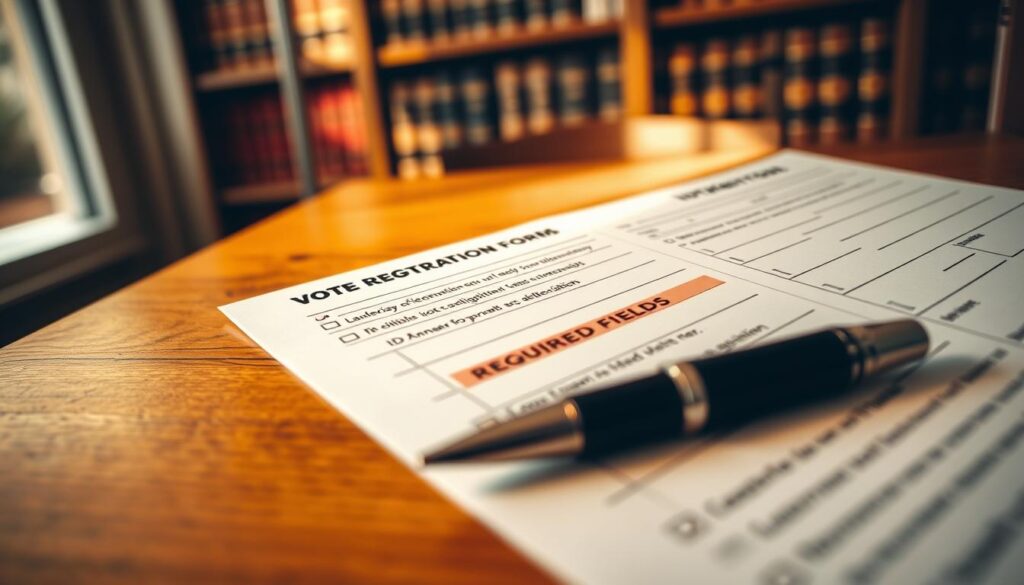
Legibility isn’t about winning a penmanship award. It’s about if a scanner can read your form. A messy signature or a wrong date can cause problems.
The required fields are essential. They are like the skeleton key to your voter record. Your driver’s license number is very important. It helps prevent fraud.
To avoid errors, be a careful proofreader of your own form. The table below is a helpful guide.
| Common Error | Why It Happens | The Consequence | Prevention Tip |
|---|---|---|---|
| Missing or Incorrect ID Number | Overlooked field or using an expired ID. | Application rejection or delayed processing until proof is provided. | Have your current driver’s license or state ID ready. Double-check the number against the physical card. |
| Illegible Handwriting | Rushing or using poor-quality ink. | Data entry errors (e.g., wrong street name, misspelled surname). | Use a black or blue pen. Print clearly in block letters, as if you’re labeling evidence. |
| Signature Outside the Box | Not noticing the signature boundaries. | Automatic rejection by automated signature verification systems. | Sign slowly and deliberately, keeping your entire signature within the confines of the box. |
| Incomplete or Inconsistent Address | Using nicknames (e.g., “St.” vs. “Street”) or omitting apartment numbers. | Mailing and eligibility confusion. Your voter card goes to the wrong place. | Copy your address exactly as it appears on your official mail or driver’s license. |
| Failing to Check Party Preference (in closed primary states) | Assuming it’s optional or not understanding state rules. | Being locked out of partisan primary elections. | Know your state’s primary rules. If you want a party ballot, you must check that box. |
This isn’t about doubting your intelligence. It’s about understanding the system’s literal rules. The national form is available in many languages. But the key is you, with a good pen and caution.
Every field is important. Your driver’s license number, date of birth, and full name anchor you in the system. A mistake here can cause problems.
Make your form perfect for the system. A correctly filled form is a vote waiting to happen.
Submission channels mail drop off at county office community collection rules
Submission is more than sending a form. It’s about making sure it reaches the right place, like a homing pigeon. If you send it to the wrong place, your effort is lost.
Mailing the form is a common choice. It feels like sending a wish into the world. But, you must send it to your current county election office. If you send it to the wrong place, it’s a waste of a stamp.
Dropping it at the county office is another option. It’s like visiting a temple of bureaucracy. You get a receipt and maybe a sticker. But, you must go during business hours and to the right office.
The drop box is a modern convenience. It’s placed near the clerk’s office, as seen in Union County. But, it’s tied to your town. If you move, your old box won’t work. For more on drop boxes, see our Guide to Ballot Drop Boxes.
| Submission Method | Best For | Key Rules & Deadlines | Address Change Consideration |
|---|---|---|---|
| Planners, those far from offices. | Must be postmarked by deadline. Use correct postage. Bundling is allowed but risky. | Must be mailed to the election office of your current county of residence. | |
| County Office Drop-Off | Those needing instant confirmation. | Must be delivered by close of business on deadline day. Often requires ID. | You must physically go to the office for your new jurisdiction. Old county won’t accept it. |
| Secure Drop Box | Last-minute filers, night owls. | Box must be official, located per local ordinance (e.g., near municipal clerk). 24/7 access common. | You may only use a box designated for your current municipal address. Verify location online. |
| Community Collection* | Registration drives, assisted filing. | Collector must be trained, cannot be compensated per form, must submit affidavits. | Collector must ensure forms are delivered to the correct county for each individual’s address. |
*See Section 5 for detailed third-party rules.
Community collection is like a carpool for voting. A volunteer takes your form and promises to deliver it. But, if they go to the wrong place because of an address change, your vote might not count.
The channel you choose is important. It’s the last step in a race where your vote is the baton. Pick the right one based on your current address, not where you used to live.
Voter status lookup and confirmation tools request receipt strategies
Think of voter registration confirmation as a detective story. You’re both the sleuth and the victim. You’ve sent in your form, but there’s no confirmation. You’re left with nothing but silence.
Your mission is to create your own audit trail. This is to prove you exist to the voting machine.
Your first clue is a state or county website. These sites are like old tax forms. You’ll need to enter your name, birth date, and Social Security number.
The goal is to find your status as an “Active Registered Voter.” Be patient, as these sites can be slow.
Remember, search for your status weeks before any election deadlines. Finding a problem on Election Day is a disaster. These sites are your early warning system.
Did you get a receipt? Usually, the answer is no. So, create your own paper trail. Record the names of those you registered and the date.
Follow up with them. If you registered in person, note the official’s name and badge number. This is your protection against missing ballots.
When websites fail, try a phone call. Be ready for long hold music. Have your details ready for confirmation.
Get a verbal confirmation and a reference number if possible. Add this to your audit file.
This proactive approach turns you from a passive applicant to an active participant. Keep track of key deadlines, not just Election Day. Your vote is your voice. Make sure it’s heard.
Complaint and cure processes rejection notices cure windows assistance resources
A rejection notice isn’t the end. It’s like a test with a tight deadline. The provisional process offers a second chance.
Fixing your ballot is like a game show challenge. You got it wrong, but you have one last chance. This is called adjudication, fixing mistakes like a bad signature.
The clock starts when you get the notice. Cure windows are very short. In New Jersey, you have until 5 p.m. on the 9th day after Election Day to fix it. Missing this deadline means your ballot is thrown out. It’s a race against time.
A rejection notice is more than a “try again.” It tells you why you were rejected. Was your signature wrong? Did you forget to check a box? This notice shows you how to fix it.
| Rejection Reason | Typical Cure Action | Critical Deadline |
|---|---|---|
| Signature Mismatch | Sign and return a “Cure Affidavit” or provide a new signature sample. | Often 5-9 days post-election; varies by county. |
| Missing ID Information | Submit a copy of an accepted ID (e.g., driver’s license, utility bill) via a secure portal or in person. | Same as signature cure; deadlines are absolute. |
| Incorrect or Incomplete Voter Address | Confirm your registration address and submit proof of residence if required. | May need resolution before the cure window closes. |
| Ballot Arrived After Deadline | This is often fatal; but some states allow cure if postmarked on time but received late. | Postmark rules are king; check your state’s law. |
Looking at this notice? Call your county election office. They should be on the notice. Have your ID and the notice ready. Be polite but firm.
For more help, use nonpartisan resources. Groups like the Election Protection Coalition have hotlines (866-OUR-VOTE) with lawyers. They can help you understand the process. Remember, you have federal voter registration protections under laws like the NVRA.
The provisional process is like an obstacle course. But you have the right to go through it. Use your cure window and get help. Turn that rejection into a counted vote. It’s the system’s way of saying, “We might have messed up, but you can fix it.”
Compliance checklist and links to county website forms calendars and contacts
You’ve passed the civics lecture. Now for the tactical download. Think of this as your pre-flight checklist.
Confirm your eligibility. Process any recent address changes immediately. Circle the exact deadline for your method. Assemble your ID and proof of residence. Pick your submission channel. Verify your status after filing.
This list is useless without the right forms. The source of truth is your county’s election office website. For Union County residents, the Board of Elections minutes we cited are a treasure trove of local procedure.
Find the official registration form. Locate the precise election calendar, not a generic one. Save the correct contact for when things go sideways. Your vote depends on these details.
Navigate to your county’s site. Bookmark it. Your civic power is just a few accurate address changes and clicks away.