Let’s start with a simple, ancient question: who watches the watchmen? In modern politics, we must ask: who registers the registrars?
This isn’t a philosophical puzzle. It’s the bedrock of local accountability. While partisan PACs operate in the shadows, a different ethos lights the way forward.
Consider the ironically named “WATCHDOG PAC” from New Orleans. It funneled over $53,000 into opaque operations, spent nearly $57,000, and ended with a crisp $0.00 cash on hand. How efficient!
A true nonpartisan voter registration effort is the civic antithesis. It’s not about winning a district. It’s about empowering the people within it.
With the federal Voting Rights Act looking more like Swiss cheese thanks to recent Supreme Court rulings, local action isn’t just noble. It’s a necessary defense.
Think of your County Board of Elections not as a bureaucratic backwater, but as the last firewall. This is where the real work of electoral integrity begins.
Eight week planning timeline goals permits staffing budget communications
Starting a voter registration drive without an eight-week plan is like trying to bake a soufflé in a microwave. It’s a recipe for disaster. This isn’t about casual planning. It’s a detailed logistical operation that needs a countdown.
First, set goals that are realistic. How many new voters do you aim to register? Focus on a specific area or group. A vague goal is useless. You need a clear number and a plan.
Next, navigate the permit maze. This process is complex and varies by location. You’re not just asking for permission. You’re dealing with public space rules, noise laws, and insurance. Start this search in Week 6 or 7. The bureaucracy won’t hurry for you.
Staffing is key. Volunteers can’t just grow like mushrooms. You need a clear plan: who does what, when. A confused volunteer is an inactive one.
Now, let’s talk money. Your budget should be clear and transparent. Look at real data, like the WATCHDOG PAC’s detailed breakdown. Your budget needs the same clarity.
| Budget Category | Real-World Example (PAC Data) | Voter Drive Application | Cost Estimate |
|---|---|---|---|
| Operating Expenditures | Printing, Postage, Office Supplies | Forms, Signage, Clipboards, Pens | $800 – $1,500 |
| Venue & Permits | Facility Rental, Legal Fees | Park Permits, Insurance, Site Fees | $200 – $1,000+ |
| Outreach & Communications | Digital Advertising, Media Buys | Social Media Boosts, Flyers, Community Partner Materials | $500 – $2,000 |
| Volunteer Support | Staff Salaries (in PAC context) | Training Materials, Refreshments, Thank-you Swag | $300 – $800 |
| Logistics & Security | Compliance Consulting | Secure Storage Boxes, Transport, Chain of Custody Protocols | $150 – $500 |
See the last line? That’s key. Budgeting for chain of custody items is essential. A lost form can disenfranchise voters, not just cause a minor issue.
Your community outreach should feel like a real conversation. Know who you’re talking to and where they are. Authenticity is key. This approach attracts volunteers and registrants alike. It’s marketing for democracy.
Combine all these elements into a single timeline document. Week 8 is for the big idea. Week 1 is for final checks. Every task has a deadline and an owner. This document is your guide.
Plant the chain of custody seed early with volunteers. From the start, teach them that a registration form is precious. Its journey must be tracked and secure. This mindset turns your effort into a professional mission.
Legal framework overview federal and state context plus county procedures verify locally
If election law were a cake, the federal layer would be like the fondant on top. It looks good but doesn’t add much substance. The National Voter Registration Act of 1993 and the Help America Vote Act are like the glaze. For organizers, federal law is just the background.
Your main work is at the state level. This is where the recipe gets updated, often every year. Welcome to the world of state-level Voting Rights Acts (VRAs).
Some states are building strong VRAs. California, Colorado, and Virginia are leading the way. Others are less active. In 2026, 11 states are considering VRA legislation. The results are mixed.
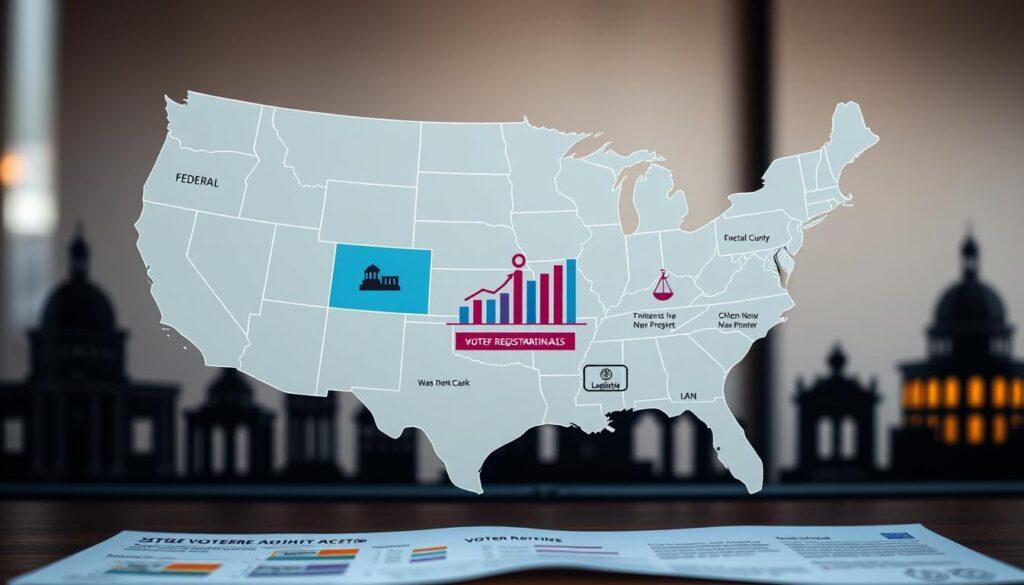
Let’s look at the scoreboard. Maryland just passed a new law. Alabama has HB 486 in the works. Georgia is debating SB 536. Louisiana’s Senate Committee blocked SB 365. Progress isn’t always smooth.
This patchwork is real, not just politics. What’s legal in Springfield, Illinois, might not be in Savannah, Georgia. You need a map.
The most detailed part of that map is your county. County clerks and election offices have their own rules. This is where “transparency dashboard” becomes your plan.
Why is local verification so important? State law sets the stage, but counties run the show. They process forms and enforce rules. Miss a local rule, and your drive could fail. It’s not just about following rules. It’s about protecting your work.
To build your protection, call your county election office. Don’t rely on old websites. Ask about form acceptance, deadlines, and notarization. Document every answer. This is the start of your transparency dashboard.
Think of it this way: the federal layer is thin. The state layer is unstable. Your county’s procedures are what you stand on. Verifying them is the first step.
This legal layer cake is complex. But for a savvy organizer, that complexity is an opportunity. Mastering it makes your nonpartisan voter registration effort precise and powerful. You’re not just handing out forms. You’re navigating a system. And now, you have the fork.
Site selection and permissions public facilities libraries campuses events faith locations businesses
Forget about finding the best retail space. The most valuable spot for voter registration is where people already trust each other.
You’re not just picking a spot. You’re setting the mood. Libraries are official yet safe. Campuses are lively. Churches offer a sense of community. Choose well, and you make it easy for people to register.
Let’s explore the best places. Your goal is to meet people where they are. Here’s how to turn any location into a voter registration spot:
- Public Libraries: The go-to spot. They’re neutral, trusted, and visited by many. It’s like a warm, welcoming place.
- College Campuses: Meet the future voters here. Set up near student areas. It’s a chance to catch their attention between classes. For more on campus voter engagement, check out this issue brief.
- Community Events & Festivals: A great chance to engage people. They’re out, happy, and open to new things. Farmers markets and cultural fairs are perfect.
- Faith-Based Locations: Approach with care. These places have a lot of trust. Make sure your voter registration effort is respectful and nonpartisan.
- Local Businesses: Places like coffee shops and bookstores are community hubs. A business owner’s support can be powerful. Just make sure it feels like a community service.
Make accessibility your top priority. Think about the effort to place polling stations on Native American reservations. Is your site easy to get to? Is it safe and welcoming for everyone?
Getting permission is key. You can’t just set up anywhere. Call your local county board of elections to find out what’s allowed. They’ll help you avoid any issues.
For private spots, it’s about working together. Create a simple agreement that outlines everything. Make it easy for them to agree.
Always check with the county board of elections before setting up. Their approval makes your effort official and smooth. It turns a possible problem into a welcome opportunity.
Choose your location carefully. The right spot makes a big difference. It tells people, “You belong here. Your voice matters.” That’s what nonpartisan voter registration is all about.
Materials and setup forms signage ADA tables shade power Wi Fi backup paper kits
Materials and setup are key to a smooth drive. They can say “Welcome, citizen” or “Bureaucratic labyrinth ahead.” It’s all about the user experience.
First, you need the current, official registration forms. An outdated PDF won’t do. Check the version with your county every week. It’s more than paperwork; it’s a deal with democracy.
Look at your site from afar. Is your signage clear? Use big, bold fonts and simple arrows. This is your first step in community outreach.
ADA compliance is a must. Your table should be at a good height. Make sure there’s a clear path to it, without cords or obstacles. Have a chair ready. Standing in the sun is not welcoming.
Provide shade with a pop-up canopy. It shows you care about comfort. Add extra chairs for those who need to sit. This thoughtful setup builds trust.
But tech can fail. Use heavy-duty power banks with tablets. Wi-Fi might not always work. Have a backup paper kit ready. It should include forms, clipboards, and a locked box for completed ones. This box is key for your chain of custody.
Every item has its place. Pens here, forms there, and a “Completed” box there. A clear setup helps volunteers and shows competence. It’s a silent way of community outreach.
Assign someone to manage the “Completed” box. They start the chain of custody. Their job is to collect, count, and secure forms. It’s not just about tidiness; it’s about data integrity. Think of your setup as the stage for democracy. Every detail matters.
Volunteer roles and training coordinator greeter form coach intake runner compliance officer
Think of your volunteer team as a precision heist crew. Each role is cast for maximum efficiency and zero drama. Misplace a person, and the entire operation crumbles.
This isn’t about warm bodies filling chairs. It’s about deploying a specialized unit. Each member knows their part, their backup, and the consequence of a mistake.
Your success hinges on this human machinery. Let’s meet the essential cast.
The Coordinator is your mastermind. They don’t just manage a checklist; they conduct the orchestra. This person troubleshoots in real-time, allocates resources, and is the nexus of all communication.
If a Greeter is swamped or a Runner is delayed, the Coordinator recalibrates the entire flow.
The Greeter is your first line of community outreach. This role requires a disarming smile and the situational awareness of a concert bouncer. They set the tone, manage the initial queue, and identify voters who might need extra assistance before they even reach a table.
The Form Coach is the patient guide. They demystify Box 7, clarify identification requirements, and ensure every field is completed correctly. Their job is to prevent errors at the source, turning a confusing document into a simple task.
A good Form Coach saves hours of downstream correction.
The Intake Officer is the gatekeeper of data integrity. They perform the first quality check, verifying form completeness before anything is sealed or logged. This person is the last stop before the ballot enters the official chain of custody. Attention to detail is non-negotiable.
The Runner is the logistics ninja. They transport sealed envelopes from intake stations to secure storage bins or pickup points. Speed and protocol are their mantras. They understand the physical chain of custody is as critical as the digital one.
Lastly, the Compliance Officer is the rulebook incarnate. They circulate, observe, and gently correct any procedural drift. They are the on-site reference for regulations, ensuring every action from greeting to sealing withstands legal scrutiny.

Training this crew cannot be a boring lecture. It must be a drill. We script scenarios: the overly enthusiastic partisan, the confused first-time voter, the person who just needs help with their address.
This is where abstract community outreach becomes human-to-human connection.
Every drill reinforces the chain of custody protocol. Volunteers practice signing logs, sealing envelopes, and handoff procedures until it’s muscle memory. They learn why each step matters. This transforms anxiety into confidence.
| Role | Primary Function | Key Responsibility | Critical Skill |
|---|---|---|---|
| Coordinator | Operational Command | Real-time resource allocation and crisis management | Decisive leadership |
| Greeter | First Impression & Flow | Queue management and initial voter assessment | Empathetic communication |
| Form Coach | Accuracy Assurance | Guiding error-free form completion | Patient instruction |
| Intake Officer | Data Integrity Check | Final form review before sealing | Meticulous attention to detail |
| Runner | Secure Logistics | Physical transport of sealed materials | Reliability and protocol adherence |
| Compliance Officer | Procedural Oversight | Ensuring all actions meet legal standards | Regulatory knowledge |
A team trained this way is more than just effective. They are confident, adaptable, and your best legal shield. They turn chaos into a smooth, trustworthy process. That’s the real heist—stealing away doubt and delivering confidence.
Chain of custody and submission receipts deadlines delivery logs duplication checks
Think of your voter registration forms as precious cargo. They need a security detail like a presidential motorcade. It’s not just moving boxes. It’s keeping a detailed story for every form from your hand to the county board of elections.
The chain of custody protects your legal and ethical side.
Why do we use such strict rules? A lost form means a lost vote. A sloppy handoff can make people doubt the whole process. We’re building a system that would impress even a FedEx expert.
Every form batch needs a birth certificate. When you seal a bundle, make a custody log. This is a formal record with a unique ID, date, time, location, and collector’s name. Give a carbon-copy receipt to your site captain. This starts the clock.
The Deadline: It’s Not a Suggestion
Your submission deadline is set in law, not just a suggestion. Missing it is not allowed. Know your state and county’s law. Is it 5 PM on the 21st day before the election? Treat this date like a spaceship launch window. All your planning leads to this moment.
The Delivery Log: The Continuous Feed
Who has the forms? Where are they now? Your delivery log shows this in real-time. Every transfer must be signed off. Use a simple table. Digital is best, but a good paper log works too.
| Batch ID | Time Transferred | From (Custodian) | To (Custodian) | Signature |
|---|---|---|---|---|
| VR-101 | 10/03, 4:30 PM | Jane Doe (Site Lead) | John Smith (Coordinator) | J. Smith |
| VR-102 | 10/03, 5:15 PM | John Smith (Coordinator) | Secure Drop Box #4 | Log #4 Scan |
| VR-103 | 10/04, 9:00 AM | Secure Drop Box #4 | County Board Courier | Courier Badge #7421 |
Secure Transport: No Backseats Allowed
Don’t drive forms in your car. Use official drop boxes, scheduled couriers, or direct hand-delivery. If you must transport, use a locked container and two people. It’s a serious mission.
The Duplication Check: Your Final Quality Gate
Before leaving your possession, do a duplication check. Scan or quickly review for errors: missing signatures, duplicate entries, or incomplete addresses. This is your last chance to fix a flaw. It turns a rejection into an acceptance.
This process turns anxiety into audit-ready assurance. When the county board of elections asks for your chain of custody records, you’ll have a binder of calm, organized certainty. It proves you understand the job of a third-party registrar doesn’t end at the registration table. It ends only when the government has officially taken custody.
Remember, the chain of custody isn’t red tape. It’s the story of your integrity, written in ink and signatures. Make it a bestseller.
Data privacy and record keeping secure storage PII redaction retention schedules
Transparency is a double-edged sword. It requires you to protect the personal details you document. Every form you collect is a liability with good intentions. For example, the FEC filing for the WATCHDOG PAC has PII like “Jason Redmond” and a PO Box in New Orleans.
Your storage solution can’t be a simple cardboard box. It’s a recipe for disaster. You need a fortress mentality for both digital and physical records.
Digital files need encrypted backups. Think of it as a digital safe with a secret combination. For paper, use a secured cabinet in a controlled area. This isn’t paranoia; it’s necessary for a nonpartisan voter registration drive.
Redaction is key for public documents. Before sharing, you must remove sensitive information. What gets redacted?
- Full residential addresses (keep city and state).
- Driver’s license or state ID numbers.
- Date of birth details beyond year.
- Any signature images.
This process makes sensitive data usable without exposing individuals. A leak can damage trust quickly, like a politician breaking a promise.
You also need a clear retention schedule. You can’t keep everything forever, and you shouldn’t shred too soon. Here’s a simple framework:
| Record Type | Retention Period | Final Disposition |
|---|---|---|
| Original Paper Forms | Until verified submission + 90 days | Cross-cut shred on-site |
| Encrypted Digital Backups | 2 years (for audit trail) | Secure digital deletion |
| Redacted Copies for Internal Audit | 1 year | Shred/Delete after cycle |
| Public Metrics & Dashboard Data | Indefinitely (anonymized) | N/A – Public record |
This system meets cybersecurity standards while keeping data accessible. It turns chaotic paperwork into a managed asset. Your transparency dashboard shines because the data behind it is well-protected.
Responsible data stewardship is essential but unsexy. It’s the foundation for a nonpartisan voter registration effort to be both open and secure. Trust is built by showing you can handle sensitive details. Get this right, and your credibility becomes your strongest asset.
Metrics and transparency publish counts acceptance rates rejection reasons processing time
Your drive’s success isn’t just about empty pizza boxes. It’s about the county board of elections metrics. The event is a show. The data is the real review.
Submitting forms is a hopeful act. Publishing results is a sign of accountability. It’s like your civic financial report. Without it, you’re just sharing a story. With it, you’re showing proof.
So, what’s on the audit docket? Four key metrics:
- Total Submission Count: Your raw output. The number of forms you handed over.
- Acceptance Rate: The percentage the county board of elections found complete and eligible. This is your success rate.
- Rejection Reasons: The “why.” Was it a data entry problem or an eligibility issue? This shows where you need to improve.
- Processing Time: The time from your drop-off to their confirmation. This shows how efficient the system is.
This data should be public, not hidden. It needs a transparency dashboard. Think of it like the FEC’s summary page for a PAC. It shows total receipts, disbursements, and cash on hand. It’s simple, public, and honest.
Having this dashboard does three important things. First, it builds trust for your next effort. You’re showing proof, not asking for it. Second, it shines a light on the system itself. Is the county board of elections processing registrations fast or slow? That’s accountability.
Lastly, it changes you. You’re no longer just an event organizer. You become a civic data provider. This is the difference between saying “we had a drive” and proving “we added 247 verified voters, with a 94% acceptance rate, and the main rejection reason was incomplete prior address info.”
Like Maryland’s Voting Rights Act looks for evidence of “polarized voting” to diagnose issues, your dashboard shows procedural health. It turns stories into data. It’s how you prove the good you did.
Post event follow up neutral voter education resources and continuous improvement loop
The last form is scanned. The metrics are public. Is the job done? That’s where most drives fizzle out. The real magic starts now.
Your nonpartisan voter registration effort must complete the civic journey. New voters need a neutral guide. Tell them how to find their polling place. Provide a simple, unbiased look at the candidates. This isn’t advocacy. It’s essential community outreach.
Look at Flagler County, Florida. Their “Take A Future Voter To Work Day” turns registration into a lasting lesson. States like Vermont codify this in law, with bills like SB298 funding voter education. Your follow-through builds trust.
Next, gather your team. Have a brutally honest debrief. What was smooth? What was a total dumpster fire? This creates a continuous improvement loop. Document every lesson.
That loop turns a single event into a permanent operation. It builds a savvy, trusted civic infrastructure in your community. You stop being a one-day wonder. You become the reliable watchdog. That’s how a registration drive evolves into a real movement.