Let’s be honest. Your city council race is like a critically acclaimed indie film. Everyone says it’s important, but few actually show up.
This isn’t a scolding civics lesson. It’s a deep dive into why local decisions affect you more than national news.
The math of apathy is scary. In non-compulsory systems, voter turnout often hits historic lows. A 44% turnout, like in Ontario, is often seen as a “good” year. This shows a clear failure in communication.
To increase participation, we need more than guilt. We need thoughtful incentives and a new way to see civic action. Think of it as hacking for your local community.
So, how do we solve this problem? We need advanced voter outreach strategies. These should treat voters like people, not just numbers.
For more on this, check out advanced voter outreach strategies that can make a real difference.
Community Engagement Tactics
Forget the big rallies; the real magic is in the quiet conversations. It’s about the subtle nudge and shared experiences. These human-centric tactics are key to boosting voter turnout.
Start with surveys, but not just any surveys. They’re a way to understand why people might not vote. It’s about finding out if it’s apathy, confusion, or distrust. Civic platforms like Granicus show that listening is the first step to a successful strategy.
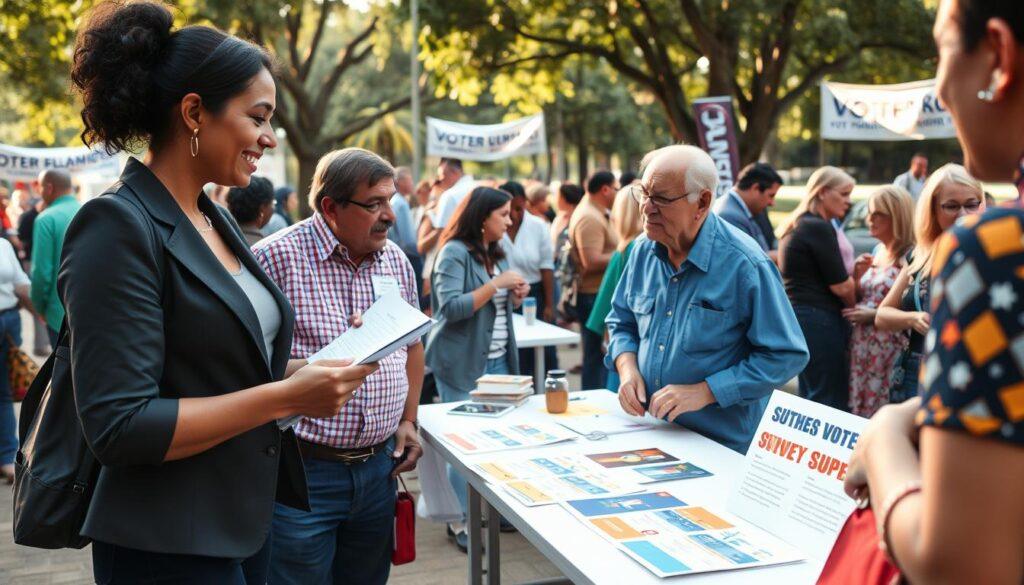
Then, there’s the timely reminder. If no one remembers an election, does it matter? The “nudge” theory of behavioral economics helps here.
A reminder email when you’re near your voting place isn’t spam. It’s a helpful nudge. It turns voting into a tangible action, not just an idea.
The “I Voted” sticker is more than a trinket. It’s a sign of belonging. It encourages others to vote, making a big difference in local races.
Civic education is key, not just nice to have. It’s about clear, easy-to-understand information. Knowing what local issues are about builds confidence and gets people to vote.
An informed public is more likely to vote. Clear explanations of local issues are essential.
Transparency is also critical. You can’t build trust with secrets. If promises can’t be kept, explain why. Honesty strengthens a campaign, turning skeptics into supporters.
Before investing in digital tools, focus on these analog skills. Listen, remind, celebrate, educate, and speak honestly. This is how you build a strong GOTV operation that actually gets people to vote.
Event & Outreach Ideas
Imagine voting as a top-notch service, where ease and fun are the main goals. This is where we focus on creating a great experience. We aim to make civic action easy and fun for everyone.
First, let’s talk about how we vote now. The old way of voting is outdated. It expects people to go to a specific place on a certain day. It’s hard and not very convenient.
Mobile polling stations are a smart idea. Places like Canada have already seen its success. For example, Thunder Bay and Sudbury used vans and buses to make voting easy. It shows respect for people’s time.
But why just use buses? Let’s make voting a part of community life. Set up polling stations at places people already go, like farmers’ markets and college campuses. Kitchener, Ontario, did this and saw great results.
Accessibility is key. It’s not just about following the law. It’s about making voting easy for everyone. This means:
- Easy physical access.
- Simple language on ballots.
- Options like early voting and mail-in ballots.
Windsor gave free bus rides on election day. This shows how removing barriers can increase voting. It makes people feel valued and invited to participate.
So, how do we put all these ideas together? It’s about making voting convenient and fun. A mobile station at a festival is more than a place to vote. It shows the vote is important to the community.
The results of these efforts are clear. When voting is easy and fun, more people do it. It’s not complicated. It’s about treating citizens as customers and making them happy.
Digital Tools
Let’s look at the digital tools used in modern campaigns. We’ll find out which ones really help increase voter turnout. This is about using data to make a real difference, not just having lots of apps.

Remember Facebook’s “I Voted” button? It had a small but real impact on voting. It was like a digital push to vote. But, it was much better than random social media ads.
For real results, focus on emails and texts. Automated reminders are key in getting people to vote. SMS messages are also effective because they’re direct and personal. Adding a link to check voter status on official voter portals makes it even better.
The pandemic changed how we campaign and vote. Now, virtual town halls and TikTok are essential. They help reach people who don’t watch traditional media.
After voting, digital tools help keep trust. Features like ballot tracking make voters feel secure. Keeping in touch after the election helps voters stay involved.
The best digital tools make voting easier. Text reminders and ballot tracking reduce stress. Virtual events make it easier to participate.
While “voter apps” might seem promising, they often confuse people. The real power lies in simple, automated tools. These tools meet people where they are, like on their phones.
The best tool is one that understands people. It’s the nudge, reminder, or update that makes voters feel informed. This feeling is what drives people to vote.
Success Metrics
The confetti’s swept up and the social media ads have stopped. Now for the real party: the data. How do you prove your innovative engagement moved the needle in your local elections?
Political science gives us our playbook. Field experiments show door-to-door canvassing can lift turnout by 2-4 points. That personal touch has a cost—about $31 per vote—but it crushes impersonal robocalls. A well-crafted social pressure mailer can be unnervingly effective. This is the cold, hard math of democracy.
Look beyond the top-line number. Measure demographic shifts in participation. Track if newly engaged voters return next cycle, because voting is famously habit-forming. This long-game analysis proves engagement isn’t just feel-good PR. It’s a measurable strategy for healthier local elections.
Your metrics should inform the next cycle. Resources like Granicus’s guide on 10 strategies to boost voter turnout can help refine your approach. The goal is clear: turn inspiration into impact, one proven metric at a time.