The East-West Transit project moved from planning into construction on October 6, 2026, giving Baltimore City and Baltimore County residents a new set of transit, street, sidewalk, and bus-stop changes to watch over the next several years. The Maryland Department of Transportation Maryland Transit Administration said the RAISE project will be built in phases through 2029, with work tied to the CityLink Blue and CityLink Orange corridors that connect western Baltimore County, downtown Baltimore, and eastern Baltimore County.
What The East-West Transit Project Changed
East-West Transit Timing And Phasing
MDOT MTA said construction began on October 6, 2026, and will continue in phases through 2029. The agency identified the work as the RAISE East-West Transit Priority Project and said the total project cost is $50 million, including a $22 million federal RAISE grant, with other funding coming from state and local contributions. The agency also described the corridor as a 20-mile stretch following the CityLink Blue and CityLink Orange routes from the Centers for Medicare & Medicaid Services in western Baltimore County, through downtown Baltimore, to Fox Ridge in eastern Baltimore County, according to MDOT MTA’s construction announcement.
What Riders May See On The Street
The same MDOT MTA announcement said planned work includes dedicated bus lanes, bus stop improvements, bus bulbs, queue jump lanes, transit signal priority, real-time passenger information signs, lighting, and pedestrian and bicycle safety upgrades. For riders, that means the project is not only about buses moving faster. It is also about how people reach stops, wait at stops, cross streets, and move around buses in busy corridors.
For residents and neighborhood groups, the practical question is where each phase affects daily travel. A dedicated bus lane can change curb use. A bus bulb can change how a bus stops in traffic. Signal priority can change how buses move through intersections. Those are technical pieces, but they have street-level effects for riders, drivers, pedestrians, cyclists, nearby merchants, schools, and service providers along the route.
Where The Corridor Matters For Daily Riders
Ridership And Reliability Before The Pandemic
MDOT’s grant narrative reported that CityLink Blue and CityLink Orange carried more than 18,500 riders on a typical weekday in Fall 2019, before the COVID-19 pandemic. The same narrative reported on-time performance of about 68.3 percent for CityLink Blue and about 63.0 percent for CityLink Orange, with late-trip rates of about 25.1 percent on Blue and about 30.4 percent on Orange. Customer satisfaction scores were reported at roughly 3.06 for Blue and 3.15 for Orange on a five-point scale, according to the MDOT RAISE grant narrative.
Why Reliability Is A Civic Issue
Those figures help explain why the corridor is a public-service issue as well as a transportation project. When a high-use bus route is late, the effects can reach job schedules, medical appointments, school trips, transfers, and access to public offices. The project’s stated focus on bus lanes, signals, stops, lighting, and crossings speaks to the daily conditions riders face before and after the bus arrives.
The East-West Transit corridor also crosses several local jurisdictions and activity centers. That makes public coordination important. Baltimore City, Baltimore County, MDOT MTA, and other public agencies may each have interests tied to streets, safety, service reliability, sidewalks, and access. Residents do not need to be engineers to ask useful questions. They can ask how work zones will be noticed, how temporary stop changes will be posted, how pedestrian access will be protected, and how riders with mobility needs will be accommodated during construction.
How Residents Can Track East-West Transit Work
Records To Watch During Construction
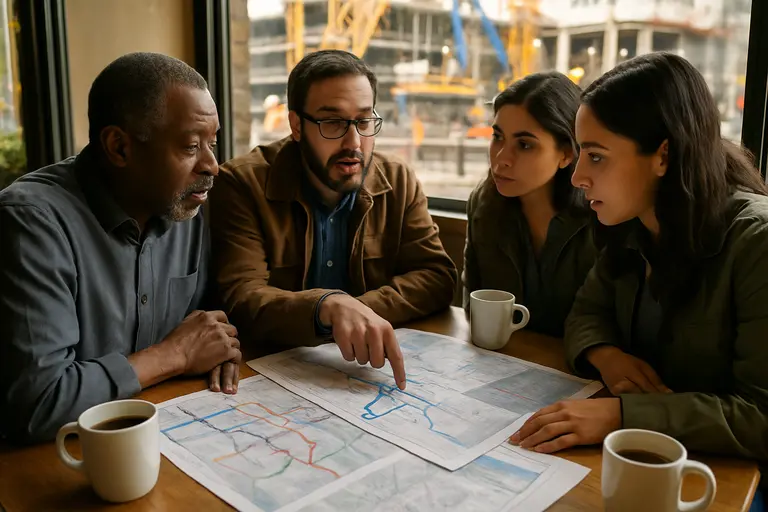
The most useful civic habit during a phased project is to separate project goals from project records. Goals describe what an agency intends to build. Records show what is scheduled, funded, changed, delayed, approved, or completed. For a project running through 2029, residents should expect many smaller decisions rather than one single public action.
Community associations, transit riders, and small businesses can track agency notices, construction phase updates, bus stop postings, public meeting materials, and local transportation board discussions. If a stop is moved, a lane is changed, or construction affects a crossing, the key public questions are direct: who made the decision, what notice was given, how long will it last, and what option is available for riders who depend on that location?
- Check whether construction notices name the affected street segment, stop, or intersection.
- Ask whether temporary bus stop locations are accessible and clearly posted.
- Compare agency updates with on-the-ground conditions reported by riders and nearby organizations.
- Watch for changes that affect pedestrians, cyclists, delivery access, and people transferring between routes.
Community Input After Work Has Started
Public input does not end when construction starts. In a phased transit project, residents can still raise issues about detours, stop access, sidewalk barriers, lighting, and communications. A project of this length gives civic groups repeated chances to document concerns in writing and direct them to the responsible public agency.
That documentation matters because individual complaints can be hard to track over time. A neighborhood group can keep a shared log of dates, locations, photos, agency responses, and changes made. Riders can do the same through a transit-focused committee or community organization. Residents following similar local civic infrastructure issues in other places can also use ITPR civic updates as a related community resource.
Baltimore’s East-West Transit Project
What To Measure Over Time
Baltimore’s East-West Transit Project should be judged by public records and rider experience as construction moves through its phases. The available MDOT documents set clear baseline issues: high ridership, reliability challenges, and planned street-level improvements. The public record over the next several years should show whether work is delivered in phases, how changes are communicated, and how riders are protected while streets and stops are under construction.
For local residents, the next civic step is steady follow-through. Watch for phase maps, schedule changes, bus stop notices, and agency explanations of construction impacts. Ask specific questions tied to specific locations. Share written concerns through neighborhood associations, transit advocacy groups, and official agency channels. A transit project succeeds in public life not only when concrete is poured or signs are installed, but when residents can see what changed, why it changed, and how to use the service safely during the work.