Ever feel like you’re trying to orchestrate a symphony where the violinists are on TikTok, the conductor is in a budget meeting, and the tuba section just formed a union? Welcome to the beautiful chaos of modern organizational life. Mapping the players isn’t just administrative busywork; it’s the secret decoder ring for getting anything done.
I’ve been in those district offices. The air is thick with policy memos and lukewarm coffee. You quickly learn that a static org chart is about as useful as a map of Middle-earth for your daily commute. The real power flows through a dynamic, often messy, stakeholder map.
This isn’t about putting names in boxes. It’s about understanding the motivations of a principal juggling test scores and parent emails. It’s about hearing the genuine concerns of student groups beyond the rally posters. It’s about aligning with the faculty advisors who are the true institutional memory.
Forget top-down mandates. Lasting change happens when you navigate this human ecosystem intelligently. Let’s break down the art and science of who matters, why they matter, and how to actually engage them.
Objectives pre registration where allowed and first time voter support
Imagine giving a 17-year-old their democracy membership card before they can legally buy a lottery ticket. That’s the power of pre-registration. It’s not just a formality; it’s a powerful start.
This simple policy lets 16- and 17-year-olds sign up early. It’s key for any high school outreach program. It tells young people, “You’re already part of this system.”
CIRCLE’s data shows a big impact. Counties with pre-registration laws saw a 9-percentage-point increase in youth voting rates. This is not just a small change; it’s a big boost in voting.
States like Massachusetts and Utah are leading the way. Virginia and Ohio are also on board. They’ve made it clear: you don’t have to wait until you’re 18 to register.
Good high school outreach is more than just handing out forms. It’s about building a voting habit. It turns first-time voters into confident citizens.
Pre-registration is the heart of a strong high school outreach plan. It’s not just about getting signatures. It’s about making voting easy and seamless.
Think of it as a way to make voting easier. We’re making it simpler to participate. The worry of “How do I register?” is gone before it starts.
The goal is clear. Architect the gateway. Use existing laws as a guide. In places without them, the fight for the policy is part of the outreach. Building democracy starts early, not just at the polls.
Stakeholder map district offices principals student groups faculty advisors
Forget the org chart. The real power structure for a school-based voter drive looks like a social network diagram. Peer educators are at the center, buzzing with activity.
This isn’t a solo mission. It’s a web. The state might say “promote student leadership in civic engagement.” But the real action happens where many interests meet.
Principals are the gatekeepers, controlling the school’s rhythm. District offices manage the budget and policy. Get them on board, or your plan is doomed.
Faculty advisors are the idealistic chaperones. They have the institutional memory and the adult signature needed. And don’t forget local election clerks, who manage the machinery of voting.
This is the ecosystem. State codes point to all these players, saying, “You could do something.” The magic happens when peer educators are activated.
State codes promote student leadership for a reason. Training turns students into credible distributors of democracy. They’re not just learning; they’re enacting it through peer-to-peer persuasion.
A memo from the district office is just noise. But when a respected junior talks about registration during lunch, it’s a signal. Student leaders make policy real in hallway conversations.
The energy isn’t in a mandate from the superintendent. It’s in the distributed network of influence. Principals open doors, districts provide cover, and advisors guide. But peer educators are the ones who get the work done. That’s the map. That’s the play.
Policy and compliance room reservations materials distribution FERPA boundaries
The NSLVE investigation turned FERPA into a tool for political control. It made campus efforts to help students chill. The National Study of Learning, Voting, and Engagement aimed to see if students voted. But, right-wing activists used it to claim privacy violations.
This led to a federal probe, creating a scary atmosphere. Now, college staff are cautious when helping students register. They worry about audits, fearing misuse of federal funds for voter outreach.
Booking the student union for voter info nights is now a big deal. It’s not just an email to facilities. It’s a formal request that must avoid campus politics and legal risks.
Distributing voter registration forms is also tricky. You’re seen as a materials distributor, facing policies on solicitation. These policies can be confusing, making it hard to know what’s allowed.
FERPA, the Family Educational Rights and Privacy Act, is at the center of this. It’s meant to protect student records. But, the Trump-era guidance made it a tool to silence. The message was clear: sharing data, even for nonpartisan reasons, was risky.
To navigate this without a law degree, you need to be strategic. Know the real FERPA boundaries. Understand what data you can use and for what purpose.
- Directory Information is Your Friend: Schools can share things like name and email without consent, unless a student opts out. This is often used for voter registration.
- Context is King: Using student data to help with registration is usually okay. But using it to guess or sway political views is not. The NSLVE probe made this line blurry on purpose.
- Partner with the Institution: Work through official channels like the Registrar’s office. They know what’s FERPA-compliant for civic engagement.
- Document Everything: Keep records of all approvals for room bookings and material distribution. In a compliance audit, paperwork is your defense.
The goal is not to scare you. It’s to give you the knowledge to overcome fear. By understanding FERPA considerations, you can create effective and compliant programs. You learn to stay within the limits without getting caught.
Residency and mailing address guidance dorm and apartment scenarios
Asking a college student “where do you live?” is like asking a philosopher to define “truth.” You’re in for a long, complicated answer with real-world consequences. Is home the cinder-block dorm room, the off-campus apartment with the leaky faucet, or your parents’ address you haven’t used in nine months? This isn’t existential angst. It’s the number one bureaucratic tripwire for young voters.
The system was built for settled adults. It expects utility bills, mortgage statements, and a driver’s license from the local DMV. For the migratory scholar living out of a suitcase, these requirements are a de facto exclusionary policy. Consider this: 40% of 18-year-olds don’t have a driver’s license. In states like New York, that number is even higher.

Relying on the DMV as the gatekeeper for student residency proof is like using a fax machine to send a TikTok. It completely misses the reality of modern life. Urban youth, in particular, get caught in this trap. They are disproportionately affected by a system that doesn’t recognize their legal address.
So, what’s the practical guidance? We need to translate the chaos of student life into the neat legalese that election officials understand. It requires walking students through their specific scenario with the precision of a tax advisor.
Let’s break down the common dorm and apartment scenarios:
- The Dweller in University Housing: Your official “home” is often the university itself. The key document here is a letter from campus housing or a tuition statement showing your on-campus address. Some states explicitly accept these. Your mission is to get this document and confirm its validity with local election rules.
- The Off-Campus Renter: You have a lease! This is gold. A signed apartment lease is typically a top-tier proof of residency. Treat it like a treasure map to your voting booth. Pair it with a piece of mail sent to that address—a bank statement or even a magazine subscription.
- The Commuter or Hybrid Student: Your legal residence might be your parents’ address. This is perfectly valid. The challenge is ensuring your mailing address (where you get your voter ID card) is current and accessible. You may need to coordinate mail forwarding or use a permanent family address.
The fight doesn’t end with guidance. We must advocate for high schools and colleges to provide IDs that satisfy state voter ID laws. We should push for institutions to affirmatively provide standardized residency documentation—a “proof of enrollment and residence” letter—akin to how a utility bill works for adults.
Arming students with the right paperwork is the first step. Getting the system to recognize that paperwork is the final, critical battle. It’s about making the law see the person in the dorm room, not just the address on a non-existent utility bill.
Curriculum aligned civics mini lessons nonpartisan speakers classroom visits
Transforming a simple sign-up into a meaningful learning experience starts with the curriculum. Let’s face it, a voter registration drive in a high school can feel like just another task. It’s not about the excitement of signing up; it’s about making it a part of learning civics.
High school outreach is key here. It shifts from asking students to sign up to understanding why their signature matters.
The Integrated Outreach Toolkit
Forget the usual assembly. Instead, focus on classroom-based activities that fit right into the lesson plan.
Civics Mini-Lessons with Local Focus: Learning about government shouldn’t just cover the basics. It should dive into local issues like school funding or zoning. Activities like observing polling sites can be a deep learning experience. Analyzing a city council race makes learning about government more real.
Nonpartisan Speakers as “How It’s Made” Experts: Having a county election official speak is like a live “How It’s Made” episode for democracy. They explain voting machines, ballot security, and canvassing. It’s not about pushing a certain agenda; it’s about showing how democracy works.
Classroom Visits as Field Trips Without the Bus: A classroom visit can bring the real world into the classroom. It could be a Q&A, a workshop on researching candidates, or a mock debate. The goal is to spark curiosity, not just hand out forms.
| Aspect | Standalone Voter Drive | Curriculum-Integrated Outreach |
|---|---|---|
| Primary Goal | Maximize form completions | Foster civic understanding & agency |
| Student Perception | Another school task | Relevant life skill & learning extension |
| Educational Depth | Minimal; procedural focus | High; connects to history, government, critical thinking |
| Long-term Impact | Unclear; may feel isolated | Stronger; registration is a logical “capstone” to a unit |
| Best for High School Outreach | Quick numbers, low time investment | Sustainable culture change, deeper engagement |
This approach leads to more meaningful activities, like those Source 3 suggests. It’s a step-by-step process:
- Foundation: Curriculum-aligned mini-lessons on voting.
- Engagement: Nonpartisan speaker sessions and classroom visits.
- Deep Learning: Essay contests, organizing forums, or designing a “get out the vote” plan.
This isn’t about teaching a certain viewpoint. It’s about inoculating against cynicism. By showing the process and reasons behind it, we empower students. When they register to vote after engaging with the material, it’s a big deal. It shows they’re ready for adulthood. That’s what high school outreach aims for.
Peer educator program recruitment training supervision incentives
A peer educator program turns students into leaders. It’s not just about signing up. It’s about building a team of civic leaders.
Recruitment is key. Look for the curious and the ones who like to organize. Students who run groups or question the cafeteria menu are your future leaders.
Places like Alaska’s youth vote ambassador program get it. They focus on Student Leadership in Voter Registration. Your job is to find these leaders before they know they are.
Training is where enthusiasm meets skill. It’s not a quick lecture. It’s a deep dive into law, forms, and how to ask others to vote.
Peer educators need to know the basics well. They also need to talk to friends without sounding like a teacher. Practice explaining rules and being confident.
Supervision should be light. You’re the coach, not the boss. Set goals and let them lead. They learn by doing, not just listening.
Check in and offer help when needed. But let them handle their successes and small mistakes. Trust is key to leadership.
Now, let’s talk about incentives. Pizza parties are nice, but think bigger. Offer things that matter to teens, like proof of impact for their future.
| Traditional Incentive | Strategic Incentive (The Upgrade) | Why It Works |
|---|---|---|
| Free Pizza | Formal Leadership Certificate | Tangible, resume-ready proof of skill and commitment. |
| Vague “Community Service” | Documented Hours for Scholarship Apps | Meets a concrete need for college-bound students. |
| Thank-You Email | Stipend or Mini-Grant for School Club | Provides real resources and acknowledges work as valuable. |
| School Announcement | Letter of Recommendation from Principal/District Official | Leverages institutional authority for the student’s benefit. |
This isn’t bribery. It’s recognizing the hard work of your peer educators. They bring energy and credibility that adults can’t match.
A good program does more than register voters. It builds a group of young people who understand democracy. They don’t just learn about engagement. They create it.
Event models tabling at orientation voter info nights residence hall canvass
If the campus voter registration table is like a sad monologue, then a true college campus drive is a grand play. It needs a variety of acts, each for a different audience. It’s not just one event; it’s a series of events that are part of student life.
At the start, tabling at new student orientation is key. You catch students when they’re full of hope. It’s not about deep policy talks. It’s about being visible and getting them to register.
For a deeper impact, you need an event. The voter information night is perfect. Instead of a boring lecture, offer a workshop or a debate. This makes learning about voting engaging and fun.
The residence hall canvass is the real game-changer. It’s like door-to-door canvassing but in dorms. Student volunteers, your peer educators, go from floor to floor. They’re not strangers; they’re friends. This approach makes voting seem like a normal part of life.
Each model in your plan has its own role. Think of them as a strategic trilogy:
- Tabling: Broad awareness and convenience.
- Info Nights: Deep education and community building.
- Hall Canvassing: Targeted, peer-driven activation.
The best drives use all three, touching students in different ways. Some like the quick sign-up at a table. Others need the depth of a workshop. And many will only act when a friend asks them. With the right policies, your drive can reach every corner of campus, not just the student union.
Parent and guardian engagement permission communication family language access
Student voter registration isn’t just about the campus. It’s about the family kitchen table too. It’s not just a permission slip for a field trip. For many young voters, it’s a family effort.
The biggest challenge is often solved at home. The proof-of-address document is usually in a parent’s filing cabinet. The notarized letter for a dorm address is discussed over dinner. Setting up student residency for voting is a family affair.
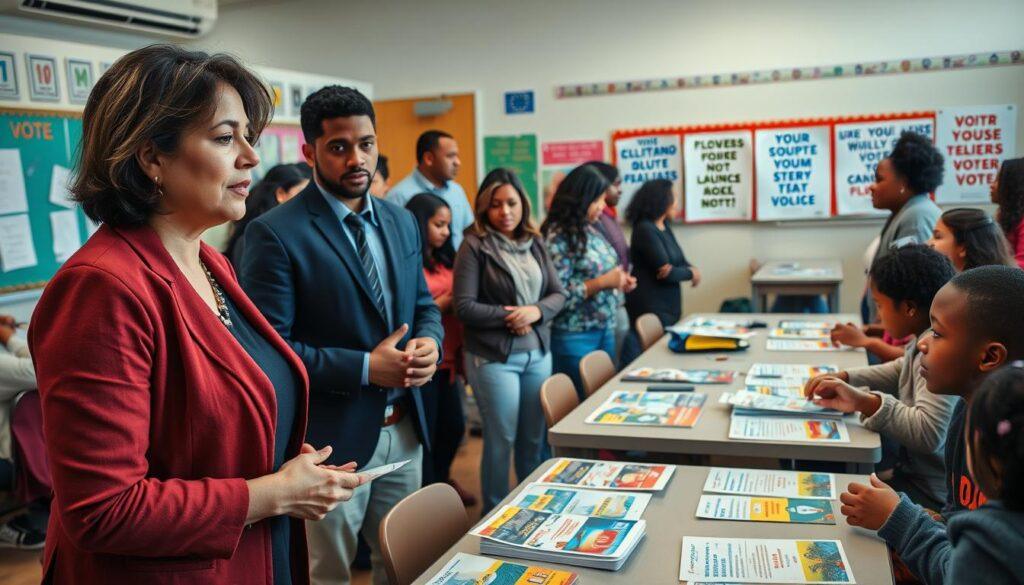
Your communication strategy needs a big change. View voting as a family milestone, not just a personal choice. This makes it a celebration, not just a request. Language access is essential. Translating materials is more than helpful; it’s necessary. Make sure to offer materials in the top languages spoken at home.
The shift from a simple request to a family milestone is significant. Let’s look at the details.
| Criteria | Traditional Permission Slip Model | Strategic Family Engagement Model |
|---|---|---|
| Primary Goal | Liability waiver, basic notification. | Build family as civic allies, upgrade household capacity. |
| Communication Tone | Formal, institutional, legalese. | Celebratory, explanatory, “kitchen-table diplomacy.” |
| Language Access | English-only, maybe one translation. | Materials in top 5 home languages; hotline support. |
| Approach to Student Residency | “Student must figure it out.” | “Let’s guide your family in navigating student residency proof.” |
| Long-term Outcome | One registered voter, possible family confusion. | Multiple informed civic participants; family becomes repeat resource. |
The right column shows a partnership with the family. The student residency row is key. Instead of leaving a student to figure it out alone, you’re helping the whole family. This turns paperwork anxiety into a family achievement.
This approach is about collective responsibility. By involving parents and guardians, you help a student and their family understand the power of student residency. It’s not just about registering a voter. It’s about making the whole household active in civic life.
Data and safety protocols consent photo policy emergency procedures
Think of your student voter data like plutonium: incredibly useful, yet dangerous. It needs strict protocols, like a spy’s secrets. After the NSLVE investigation, that simple list of emails is a big risk. You must create a system that’s as secure as a congressional hearing.
Consent is key. You can’t assume students want their info shared. Every piece of data, even if it’s just a number, needs a clear “yes.” Your consent form should be simple, like a recipe. It should explain what data you’re collecting, how it will be used, and who will see it. And don’t forget how you’ll delete it.
Photo policies are also critical. A simple photo can be seen as campaign material. Your photo release form must be clear. It should say exactly how the photo will be used, like in a newsletter or presentation. Any vagueness can lead to big problems.
Safety goes beyond just fire exits and first aid. What if a debate breaks out at your event? How do you handle questions about a volunteer’s eligibility? You need plans for legal, reputational, and emotional safety. Using a standard response protocol for disruptions is essential.
| Protocol Area | Common Pitfall | Best Practice | Required Documentation |
|---|---|---|---|
| Data Collection | Assuming implied consent for “internal use.” | Explicit, written opt-in for each data type and use case. | Digital consent form with timestamp and IP log. |
| Photo/Media | Blanket permission for “promotional purposes.” | Specific, limited use authorization (e.g., “for the 2024 campus activities report only”). | Signed photo release, separate from general event waiver. |
| Event Safety | Only planning for medical or fire emergencies. | Scenario planning for partisan conflicts, credential challenges, and disinformation. | Incident response flowchart and designated lead contact list. |
| Data Retention | Keeping everything “just in case.” | Scheduled purging of raw data post-election; archive only anonymized summaries. | Data destruction schedule and certificate of deletion. |
Handling sensitive information is like curating a museum. Use encrypted drives and password-protected files. Train every volunteer on FERPA considerations until it’s second nature. A data breach can destroy your reputation overnight.
Your emergency plan should be always ready, not just a PDF. Practice drills and role-plays. Know who to contact in emergencies. This level of pre-planning objectives makes your event run smoothly.
Strong data and safety protocols show you’re serious and professional. They build trust with students, administrators, and outsiders. This way, you turn a risk into an opportunity for trust and maybe even a good night’s sleep.
Evaluation semester dashboard retention of volunteers and next cycle plan
Without a dashboard, you’re flying blind. The NSLVE data blackout left campuses in the dark for 2024. Your own data is now your compass.
Track the numbers. How many registrations came from the engineering quad? What was the real cost per form? This goes beyond bean-counting. It’s intellectual detective work for your college campus drive.
The qualitative stories matter more. Why did your best volunteer quit after two weeks? Which tabling session had students lining up? Answers live in exit surveys and casual debriefs.
Volunteer retention is the lifeblood. A sustainable drive needs people who return. Find out what makes them stay. Pizza is a tactic. A sense of purpose is a strategy.
This intel fuels the next cycle plan. You take what worked, scrap what didn’t, and adapt. The CIRCLE Growing Voters framework is built on this loop: act, evaluate, improve.
Your final move isn’t a report. It’s a blueprint. You’re not just running a college campus drive. You’re building a learning organization dedicated to democracy. The 2026 plan starts the day after the 2024 polls close.