Ever had that Thanksgiving dinner where Uncle Bob wouldn’t stop talking about election fraud? Welcome to America’s polarized landscape, where nonpartisan work matters more than ever.
This is your orientation to democracy’s beautiful chaos. We’re not here to push agendas. Instead, we’re political Swiss Army knives, versatile and surprisingly effective.
Our mission? Contact voters with key election information. We encourage participation through every channel. And we verify registration status like digital detectives solving civic mysteries.
This isn’t about red or blue. It’s about empowering citizens to find their voice in the beautiful, messy symphony of democracy.
Eligibility basics and legal red lines
Welcome to learning the rules of politics before you start. It’s like knowing red means stop before you drive. Same idea here.
Every campaign has both experienced and new volunteers. Newbies need a basic political education. It’s like a crash course in civic duty.
Let’s talk about the rules of engagement. Breaking election laws can kill volunteer enthusiasm fast. It’s like bringing a knife to a gun fight, but with registration forms and real consequences.
Who can register? The basics are simple: 18+, a citizen, not in prison for a felony. But each state adds its own twist.
What documents do you need? It’s not just about being 21 like at a bar. You need to prove identity, citizenship, and where you live. These are the three main things to show you can vote.
There are red lines you can’t cross. They’re not just suggestions. They’re like “do not touch” signs at a museum. But instead of damaging art, you’re protecting the election.
| Eligibility Factor | Basic Requirement | Common State Variations | Documentation Needed |
|---|---|---|---|
| Age | 18 years or older | 17-year-olds can pre-register in 15 states | Driver’s license, birth certificate |
| Citizenship | U.S. citizen | Some states allow non-citizen voting in local elections | Passport, naturalization papers |
| Criminal Status | Not currently incarcerated for felony | Varies from lifetime bans to automatic restoration | Court documents, release papers |
| Residency | State and precinct requirements | College students have special rules in 38 states | Utility bills, lease agreements |
Remember that scene in “The Wire” where everyone follows the rules? That’s us, but with fewer drug deals and more forms. Precision and details are key.
State-specific rules can make or break your efforts. What works in California might not in Texas. It’s about knowing the local rules.
We’re balancing civic duty and legal rules. It’s not as exciting as TV shows, but the stakes are much higher. Your training ensures we follow the rules every time.
The legal framework is there to protect the process. It’s like the rules of the game. We’re here to help everyone play fairly.
Your role is to be the gatekeeper of democracy’s front door. You’re not the bouncer who turns people away. You’re the host who makes sure everyone gets in who should.
Standard scripts and quick-check questions
Let’s be honest about canvassing scripts. They’re like training wheels for politics. They’re needed, a bit awkward, but key to success.
Volunteers often treat scripts as just ideas. This leads to long talks on taxes when we need quick voter info.
Script structure is the key. It’s like a mix of political language and sales tactics. Each word is chosen for its impact.
Start with a strong opening line. Forget “How’s the weather?” Try “I’m helping neighbors make sure their voices are heard in upcoming elections.” It’s direct and avoids controversy.
The key questions follow a pattern:
- Check if you’re registered to vote
- Confirm your registration
- Offer help if needed
- Know when to wrap up
What’s not in these questions? Opinions or personal stories. The script keeps you focused on facts.
Quick-check questions help you stay on track. Ask yourself:
- Does this follow the League of Women Voters’ voter education standards?
- Could anything sound too political?
- Is the talk about registering to vote?
Good scripts are not limits. They’re tools to guide conversations quickly and effectively.
The best volunteers make scripts feel natural. They know that straying from the script is not a bad thing. It’s just a sign of poor communication.
Your script should feel like a real chat, not a scripted speech. The goal is to make it seem spontaneous.
Done right, canvassing scripts are your most valuable tool. They turn good intentions into real action for democracy.
Handling common scenarios and FAQs
Every conversation at the door can teach us about democracy. I’ve seen many voting objections, and I’m here to share how to turn skeptics into supporters.
When someone says “My vote doesn’t matter,” don’t worry. It’s a chance to teach them. I say: “If votes didn’t matter, why would some people work so hard to make voting difficult?” This turns their doubt into a talk about voting rights.
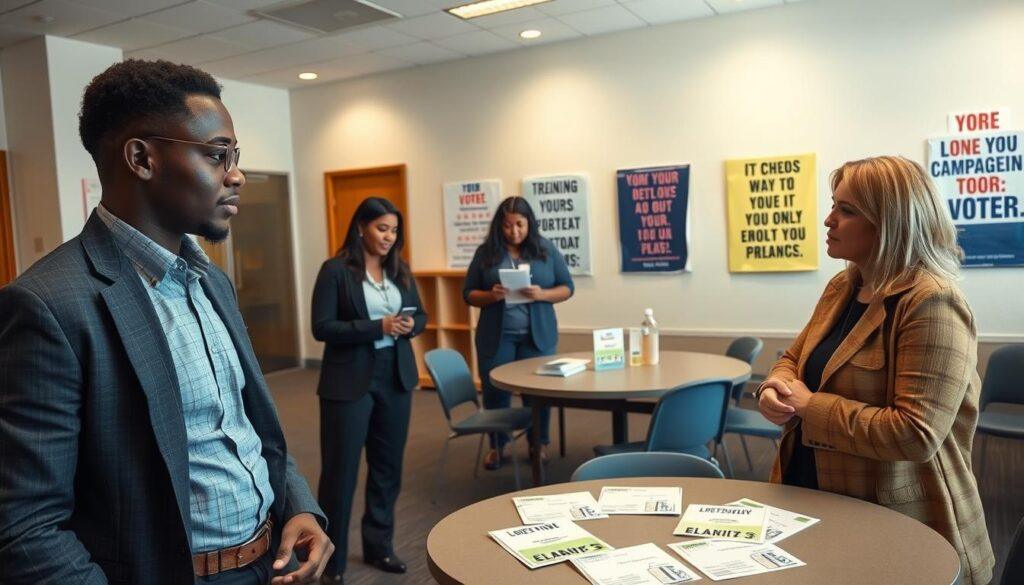
People who say “I’m too busy” need special care. We all have busy lives, thanks to Amazon Prime and microwave dinners. I reply: “Politicians make decisions about your time, money, and rights every day. Don’t you want a say in who makes those choices?”
Here’s how I handle common objections:
- “Why should I vote?” → “Because decisions are made by those who show up. Your silence is a vote for someone else’s choices.”
- “The system is rigged!” → “The best way to fix a system is from within, not from the sidelines.”
- “I don’t like any candidates” → “You don’t have to marry them—just pick the one who’ll do the least damage.”
Dealing with conspiracy theories is a big challenge. When someone questions candidate credentials with wild theories, your conflict de-escalation skills are key.
My three-step approach for tough talks:
- Acknowledge without agreeing: “I understand you have concerns about the process”
- Redirect to common ground: “We both want what’s best for our community”
- Offer tangible solutions: “Would you like information about verified candidate backgrounds?”
Many think voter registration means an IRS audit. If someone questions your credentials, show your official badge and say: “I’m with [Organization Name], here to help people exercise their rights, not take their money.”
For those who want to debate policy all day, set limits politely: “I’d love to continue this conversation, but I need to reach more neighbors today. Here’s where you can find detailed policy information.”
Remember, not all battles are worth fighting. If someone talks about aliens in local elections, thank them and move on. Democracy has enough real challenges without imaginary ones.
The magic happens when you turn objections into chances. That “my vote doesn’t matter” person? They’re often the most passionate once they see how local elections impact their life. It’s not about winning arguments—it’s about opening minds.
Cultural competency and inclusivity
Cultural competency is more than just a checkbox. It’s a key to unlocking voter registration success. I learned this the hard way when my “standard approach” failed miserably.
Remember when I tried to explain voting rights to a grandmother who survived Jim Crow? My speech felt as outdated as a flip phone. Voting is about survival, representation, and being seen for many.
Here’s a truth we must face: your biases are showing, even when you think they’re not. We all have unconscious assumptions that affect our interactions. The goal is to recognize these biases before they harm your efforts.
Think of cultural competency as emotional intelligence with a civic twist. It’s about understanding the room, even when you can’t see it. Trust must come before filling out forms.
My early mistakes? Trying the same pitch for everyone. Assuming everyone had easy access to polling stations. Believing my script was more important than their concerns.
This isn’t about being politically correct. It’s about being effective. You can’t register voters who don’t trust you. Trust comes from genuine connection, not just pretending to be woke.
The “smile while you dial” advice is more than a cute phrase. Your tone is as clear as a political ad. People can tell if you’re being real or not in seconds. A real smile can change your voice, adding warmth that scripted lines can’t.
Cultural competency means understanding different communities’ histories, communication styles, barriers, and views on voting. The magic happens when you move from assumption to curiosity.
- Varying historical relationships with voting systems
- Distinct cultural communication styles
- Unique barriers to participation
- Different perspectives on what voting represents
Instead of assuming what someone needs, ask. Instead of projecting your enthusiasm, listen to theirs. This turns voter registration into a transformative experience.
Your most powerful tool isn’t your script. It’s your ability to adapt, empathize, and connect across cultural divides. That’s where real success starts.
Language access and interpreter tips
Let’s be honest – knowing some Spanish won’t help much with ballot measures. Language barriers in voter outreach are big problems. They can keep whole communities from voting.
True language access is more than just checking boxes. It means every voter gets the same info, no matter their language. A single wrong word can make a big difference.
Professional interpreters are incredibly valuable. They handle cultural and technical terms that are hard for machines to get right. I’ve seen volunteers accidentally offend people while trying to explain voting rules. It’s a big mistake.
Here are some key tips for working with interpreters:
- Speak directly to the voter, not about them
- Use short, clear sentences without idioms
- Allow time for proper translation without interruption
- Confirm understanding through back-translation checks
Technology can be helpful, but it’s not everything. Google Voice can help you reach people in different areas. But apps can’t replace the understanding that comes from a real person.
| Communication Method | Best Use Case | Limitations | Success Rate |
|---|---|---|---|
| Professional Interpreter | Complex legal discussions | Cost, availability | 98% |
| Translation Apps | Simple directions/questions | Cultural context errors | 72% |
| Bilingual Volunteers | Basic information sharing | Technical accuracy | 85% |
| Telephone Interpretation | Immediate needs | Connection issues | 90% |
The best language access plan uses both people and technology. It’s about making sure everyone can understand, not just relying on one method.
People who don’t speak English well are not less smart or less interested in voting. They often know a lot about their community and politics. They just need the right help to vote.
Your goal isn’t to be perfect in every language. It’s to make sure everyone can understand, no matter their language. Democracy needs everyone to be able to participate, not just make noise.
Safety, de-escalation, and incident logs
Your safety toolkit for voter registration should include more than just forms and pens. It needs the awareness of a secret service agent. Democracy shouldn’t be dangerous, no matter how much you care about voting.
Start with the four-legged threats first. Always carry dog treats – it’s a good way to calm them down. For the two-legged threats, remember most problems start with misunderstandings, not bad intentions.
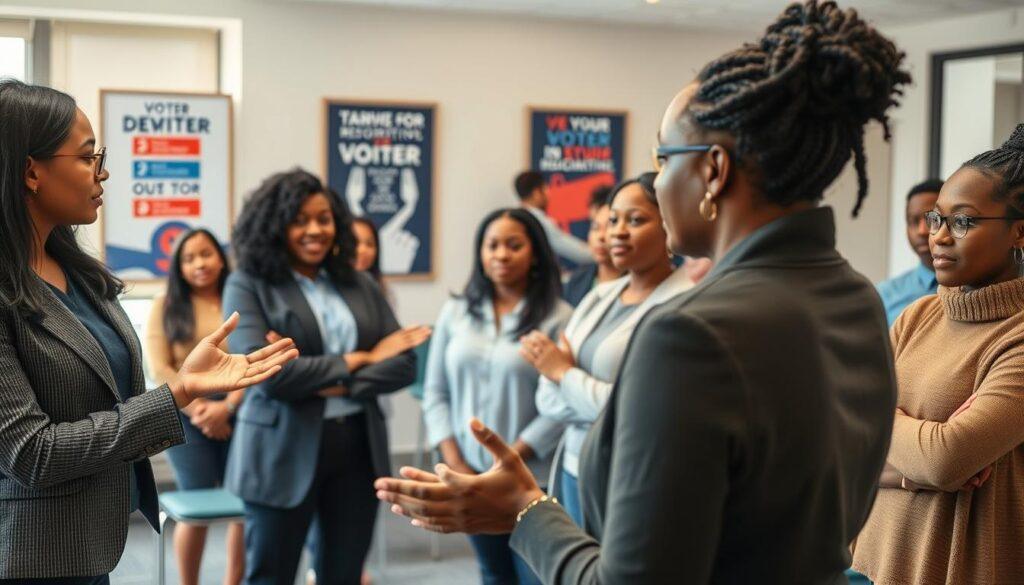
When facing voter intimidation or aggressive opponents, silence is your best friend. Say something simple and clear, like “I’m here to help you exercise your constitutional right”. If someone’s putting up unauthorized signs or making threats, document it, not confront them.
De-escalation is more art than science. Keep your body language calm and exit paths clear. Use the “listen, validate, redirect” method that hostage negotiators recommend. Sometimes, saying “I understand why you might feel that way” is the most powerful thing you can say.
Documenting incidents needs to be thorough, like the CIA. Note every interaction that feels off. Who, what, when, where, and how it made you feel. Your instincts are usually right.
| Threat Level | Recommended Response | Documentation Required | Exit Strategy |
|---|---|---|---|
| Low (Barking dog, dirty looks) | Calm continuation, treat distraction | Mental note only | Slow withdrawal |
| Medium (Angry questions, obstruction) | De-escalation phrases, call supervisor | Brief incident report | Polite excuse to leave |
| High (Threats, physical intimidation) | Immediate withdrawal, call authorities | Detailed incident log with witnesses | Immediate departure |
| Extreme (Weapons, violence) | Get to safety, emergency services | Police report mandatory | Fastest possible exit |
No registration quota is worth your safety. If something feels wrong, it probably is. Democracy needs people who care, not those who are willing to risk their lives.
The incident log system we use is impressive. Every entry creates a paper trail that protects you, your organization, and the voting process itself.
Form completion and error prevention
That simple-looking registration form? It’s actually a minefield where good intentions go wrong. I’ve seen more democratic participation fail because of small paperwork mistakes than any bad plan. The difference between a form being accepted or rejected often depends on how well you fill out the boxes.
Classic errors that make officials groan include missing middle initials. This small mistake is the top reason forms get flagged. Then, there’s the mistake of writing the wrong date, like 04/03/1990 instead of 03/04/1990, which makes the birthdate not match records. And let’s not forget field 27b, where information seems to vanish.
Remember the citizen who said their job was “Jedi Knight”? It was funny, but not helpful for checking their voter status. It’s not about stopping creativity; it’s about making sure every form is correct. Your carefulness affects whether someone can vote.
Here’s the truth: being precise is more important than being fast. Hurrying through forms leads to more work later when you have to explain why someone can’t vote. The best registration drives treat each form as a valuable item.
Your form completion checklist should include:
- Double-check all numerical information against government ID
- Verify complete name fields (first, middle, last plus suffixes)
- Confirm current address matches utility bills or other official documents
- Ensure all required fields are completed – no mysterious blank spaces
| Common Error Type | Why It Matters | Prevention Strategy | Validation Impact |
|---|---|---|---|
| Missing Middle Initial | Creates identity matching issues | Cross-reference with two forms of ID | High rejection risk |
| Date Transposition | Birthdate verification failure | Read numbers aloud while verifying | Automatic system flag |
| Incomplete Address | Cannot determine voting precinct | Use address verification tools | Processing delay |
| Occupation Field Errors | Not critical but indicates carelessness | Guide toward standard descriptions | Low direct impact |
The table isn’t just boring rules – it’s your guide to protecting voting rights. Each correct form means someone’s voice is heard. Each mistake means someone might not get to vote.
Remember, treat every form as if it’s the only one that matters. For the person whose form you’re filling out, it’s the only one that matters. Their right to vote, their voice, all depend on your attention to detail.
Chain-of-custody and returns
The chain-of-custody process makes ordinary forms into secure assets, like Fort Knox. It’s not just any paperwork. It’s the paper trail of democracy, needing careful attention. Each form is a vote, treated with great care.
Tracking forms is key to professional voter registration. It’s not about being a secret agent, but a detail-oriented librarian. Every form must have a clear path from start to finish, with no confusion.
Being accountable is your duty. Saying “I left them in my car” isn’t okay when dealing with voting rights. Every form must be tracked at every step.
Submission rules are not just for show. They make sure forms arrive safely and on time. Following these rules keeps the whole process running smoothly.
Time is as important as accuracy in this work. Late forms can cancel out registrations, just like mistakes. The clock never stops, and you can’t delay.
I’ve seen what happens when forms are not handled right. A “rainstorm incident” turned 50 registrations into mush. That volunteer taught us a lesson about how to handle forms.
Keep track of your work and share it with your team leader. It’s not just about your numbers. It’s about your team’s success when you document well.
These forms are more than just paper. They are part of democracy. Treat them with respect, or you might become a bad example. The chain-of-custody is not just a rule. It’s a way to protect democracy.
Role-play exercises and rubrics
Have you seen someone struggle to parallel park with cars waiting? That’s what unpracticed voter outreach looks like. Our role-play exercises turn awkwardness into smooth conversations.
We’ve created scenarios as varied as Coachella. From skeptical retirees to excited first-time voters, each chat is a chance to learn. We aim for real connections, not just acting.
Our exercises are based on a simple idea: practice makes permanent, not perfect. We want volunteers to feel at ease in real situations, not just recite lines.
Key scenario categories include:
- The time-crunched commuter (45-second interactions)
- The deeply skeptical citizen (myth-busting practice)
- The already-registered enthusiast (referral techniques)
- The non-English speaker (using interpreter resources)
Each role-play session focuses on real results, not just performance. We value completed registrations over awards.
Our evaluation rubrics focus on what truly matters:
- Clarity of information provided
- Appropriate tone and enthusiasm
- Effective response to objections
- Completion rate success metrics
The rubrics aim to help, not criticize. Volunteers get specific feedback to improve. We highlight strengths and suggest areas for growth.
Door-to-door simulations greatly benefit from this method. Volunteers learn to read body language and handle conversations smoothly. These skills turn awkward moments into meaningful talks.
The best voter outreach is like chatting with neighbors, not strangers. Our exercises build that comfort through practice and feedback.
Volunteers leave ready for real conversations, not just theory. They’ve faced tough scenarios in practice, so actual voters won’t surprise them.
Certification, shifts, and retention
Volunteer management is like a three-legged stool. Without all three, your efforts can fall apart quickly. Certification is like your superhero story.
Getting certified isn’t just about paperwork. It protects you legally and makes sure you’re helpful, not a hindrance. It’s like having diplomatic immunity for democracy work.
Shifts are designed for real people, not just ideals. Volunteers have jobs, families, and need sleep too.
We follow three key rules for shifts:
- Maximum 4-hour blocks (attention spans have limits)
- Clear transition protocols (no dropped ballots or information)
- Flexible scheduling (because life happens)
Retention is key, not just about pizza. Though, let’s be honest, pizza helps. The real secret is making volunteers feel useful.
Studies from election volunteer studies show satisfaction comes from feeling competent and impactful.
As you get better, you’ll enjoy the calls more. Remember, everything you do matters. Just be someone you’d like to talk to – that’s the magic.
| Retention Strategy | Effectiveness Rating | Implementation Difficulty | Long-term Impact |
|---|---|---|---|
| Proper certification training | 9/10 | Medium | High |
| Flexible shift scheduling | 8/10 | Low | Medium |
| Meaningful impact feedback | 10/10 | Low | High |
| Pizza parties alone | 3/10 | Low | Low |
Burned-out volunteers don’t help. Sustainable engagement is better than trying too hard. Your consistency is more important than being a martyr.
The best volunteers show up regularly, not just when they’re exhausted. That’s how we build lasting democracy, not just for one pizza party.
Trainer agenda and slide deck
Let’s face it—most training sessions are as exciting as watching paint dry. Your voter registration team doesn’t deserve that. Our trainer agenda turns overwhelmed organizers into confident leaders who inspire, not intimidate.
The slide deck template I’ve created shares important info without putting you to sleep. It’s all about engaging visuals and interactive moments. We mix in necessary knowledge with hands-on skill-building, because lectures alone don’t stick.
Before sending volunteers out, add role playing exercises. These help them get comfortable with scripts and real scenarios. Good trainers don’t just share info—they create spaces for growth and advocacy.
This method really boosts voter registration efforts. Your training toolkit becomes the key to driving voter engagement, one confident conversation at a time.